🚚 Kostenloser weltweiter Versand für alle Bestellungen!Jetzt einkaufen
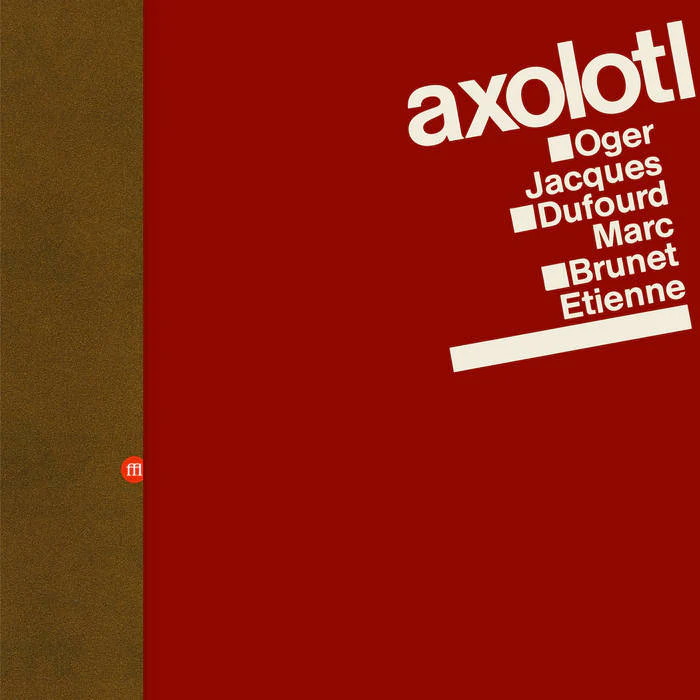
AXOLOTL - Abrasive LP
In 1981, encouraged by Jac Berrocal, Axolotl (Etienne Brunet and Jacques Oger on saxophones and clarinet, Marc Dufourd on electric guitar) recorded an album of French-style free music as iconoclastic as it was unsettling: free improvisation, jazz, no wave, contemporary, punk… a dance of labels which leaves plenty of place for the direct expression of a monstrous trio of regenerated agitators!
The axolotl is a species of salamander native to Mexico, living in a state of larva and having the capacity to regenerate damaged organs. This brief introduction doesn’t tell us if the axolotl sings. But, for the one that concerns us here: yes indeed.
In Paris, at the end of the 1970s, Etienne Brunet and Marc Dufourd would improvise regularly, inspired by some other saxophone-guitar duos: Claude Bernard-Raymond Boni firstly, then Evan Parker-Derek Bailey. When Jacques Oger (a saxophonist whom Brunet had met at a workshop given by Steve Lacy at the Châteauvallon festival in 1977) joined the duo Brunet-Dufourd, Axolotl was born.
Iconoclastic, the trio was bound to please Jac Berrocal, and he proposed to record their first album on the label ‘D’avantage’. In spring 1981 three days were just enough for Oger (tenor and barytone saxophones), Brunet (alto saxophone, bass clarinet and ‘things’) and Dufourd (electric guitar) to complete Axolotl, the first album by a group which would record … two.
If there was a collective of iconoclasts, the trio would be there with some relatives: Alterations, Fred Frith, John Zorn, the ROVA Saxophone Quartet… and then because we mention a collective, Axolotl steps (considerably) beyond the domain of free improvisation to lean towards jazz (“Illusion”, “Paris, froissé”), No Wave (“Ombre pilée”, “Trottoirs défunts”), contemporary (“Oreiller”, “D’autres seuls”), and even what we could call … acid fun (“Dehors”).
Above all, Axolotl wanted to really get to grips with sound via an expression as direct as it was liberating, as can be heard on “Ozone, flocon, torsion”, producing a noise that, even today pierces the brain. All we can hope is that now, thanks to this wonderful reissue, listeners will be able, like the axolotl, of regeneration.
The axolotl is a species of salamander native to Mexico, living in a state of larva and having the capacity to regenerate damaged organs. This brief introduction doesn’t tell us if the axolotl sings. But, for the one that concerns us here: yes indeed.
In Paris, at the end of the 1970s, Etienne Brunet and Marc Dufourd would improvise regularly, inspired by some other saxophone-guitar duos: Claude Bernard-Raymond Boni firstly, then Evan Parker-Derek Bailey. When Jacques Oger (a saxophonist whom Brunet had met at a workshop given by Steve Lacy at the Châteauvallon festival in 1977) joined the duo Brunet-Dufourd, Axolotl was born.
Iconoclastic, the trio was bound to please Jac Berrocal, and he proposed to record their first album on the label ‘D’avantage’. In spring 1981 three days were just enough for Oger (tenor and barytone saxophones), Brunet (alto saxophone, bass clarinet and ‘things’) and Dufourd (electric guitar) to complete Axolotl, the first album by a group which would record … two.
If there was a collective of iconoclasts, the trio would be there with some relatives: Alterations, Fred Frith, John Zorn, the ROVA Saxophone Quartet… and then because we mention a collective, Axolotl steps (considerably) beyond the domain of free improvisation to lean towards jazz (“Illusion”, “Paris, froissé”), No Wave (“Ombre pilée”, “Trottoirs défunts”), contemporary (“Oreiller”, “D’autres seuls”), and even what we could call … acid fun (“Dehors”).
Above all, Axolotl wanted to really get to grips with sound via an expression as direct as it was liberating, as can be heard on “Ozone, flocon, torsion”, producing a noise that, even today pierces the brain. All we can hope is that now, thanks to this wonderful reissue, listeners will be able, like the axolotl, of regeneration.
In 1981, encouraged by Jac Berrocal, Axolotl (Etienne Brunet and Jacques Oger on saxophones and clarinet, Marc Dufourd on electric guitar) recorded an album of French-style free music as iconoclastic as it was unsettling: free improvisation, jazz, no wave, contemporary, punk… a dance of labels which leaves plenty of place for the direct expression of a monstrous trio of regenerated agitators!
The axolotl is a species of salamander native to Mexico, living in a state of larva and having the capacity to regenerate damaged organs. This brief introduction doesn’t tell us if the axolotl sings. But, for the one that concerns us here: yes indeed.
In Paris, at the end of the 1970s, Etienne Brunet and Marc Dufourd would improvise regularly, inspired by some other saxophone-guitar duos: Claude Bernard-Raymond Boni firstly, then Evan Parker-Derek Bailey. When Jacques Oger (a saxophonist whom Brunet had met at a workshop given by Steve Lacy at the Châteauvallon festival in 1977) joined the duo Brunet-Dufourd, Axolotl was born.
Iconoclastic, the trio was bound to please Jac Berrocal, and he proposed to record their first album on the label ‘D’avantage’. In spring 1981 three days were just enough for Oger (tenor and barytone saxophones), Brunet (alto saxophone, bass clarinet and ‘things’) and Dufourd (electric guitar) to complete Axolotl, the first album by a group which would record … two.
If there was a collective of iconoclasts, the trio would be there with some relatives: Alterations, Fred Frith, John Zorn, the ROVA Saxophone Quartet… and then because we mention a collective, Axolotl steps (considerably) beyond the domain of free improvisation to lean towards jazz (“Illusion”, “Paris, froissé”), No Wave (“Ombre pilée”, “Trottoirs défunts”), contemporary (“Oreiller”, “D’autres seuls”), and even what we could call … acid fun (“Dehors”).
Above all, Axolotl wanted to really get to grips with sound via an expression as direct as it was liberating, as can be heard on “Ozone, flocon, torsion”, producing a noise that, even today pierces the brain. All we can hope is that now, thanks to this wonderful reissue, listeners will be able, like the axolotl, of regeneration.
The axolotl is a species of salamander native to Mexico, living in a state of larva and having the capacity to regenerate damaged organs. This brief introduction doesn’t tell us if the axolotl sings. But, for the one that concerns us here: yes indeed.
In Paris, at the end of the 1970s, Etienne Brunet and Marc Dufourd would improvise regularly, inspired by some other saxophone-guitar duos: Claude Bernard-Raymond Boni firstly, then Evan Parker-Derek Bailey. When Jacques Oger (a saxophonist whom Brunet had met at a workshop given by Steve Lacy at the Châteauvallon festival in 1977) joined the duo Brunet-Dufourd, Axolotl was born.
Iconoclastic, the trio was bound to please Jac Berrocal, and he proposed to record their first album on the label ‘D’avantage’. In spring 1981 three days were just enough for Oger (tenor and barytone saxophones), Brunet (alto saxophone, bass clarinet and ‘things’) and Dufourd (electric guitar) to complete Axolotl, the first album by a group which would record … two.
If there was a collective of iconoclasts, the trio would be there with some relatives: Alterations, Fred Frith, John Zorn, the ROVA Saxophone Quartet… and then because we mention a collective, Axolotl steps (considerably) beyond the domain of free improvisation to lean towards jazz (“Illusion”, “Paris, froissé”), No Wave (“Ombre pilée”, “Trottoirs défunts”), contemporary (“Oreiller”, “D’autres seuls”), and even what we could call … acid fun (“Dehors”).
Above all, Axolotl wanted to really get to grips with sound via an expression as direct as it was liberating, as can be heard on “Ozone, flocon, torsion”, producing a noise that, even today pierces the brain. All we can hope is that now, thanks to this wonderful reissue, listeners will be able, like the axolotl, of regeneration.
$9.72
Original: $32.41
-70%AXOLOTL - Abrasive LP—
$32.41
$9.72Description
In 1981, encouraged by Jac Berrocal, Axolotl (Etienne Brunet and Jacques Oger on saxophones and clarinet, Marc Dufourd on electric guitar) recorded an album of French-style free music as iconoclastic as it was unsettling: free improvisation, jazz, no wave, contemporary, punk… a dance of labels which leaves plenty of place for the direct expression of a monstrous trio of regenerated agitators!
The axolotl is a species of salamander native to Mexico, living in a state of larva and having the capacity to regenerate damaged organs. This brief introduction doesn’t tell us if the axolotl sings. But, for the one that concerns us here: yes indeed.
In Paris, at the end of the 1970s, Etienne Brunet and Marc Dufourd would improvise regularly, inspired by some other saxophone-guitar duos: Claude Bernard-Raymond Boni firstly, then Evan Parker-Derek Bailey. When Jacques Oger (a saxophonist whom Brunet had met at a workshop given by Steve Lacy at the Châteauvallon festival in 1977) joined the duo Brunet-Dufourd, Axolotl was born.
Iconoclastic, the trio was bound to please Jac Berrocal, and he proposed to record their first album on the label ‘D’avantage’. In spring 1981 three days were just enough for Oger (tenor and barytone saxophones), Brunet (alto saxophone, bass clarinet and ‘things’) and Dufourd (electric guitar) to complete Axolotl, the first album by a group which would record … two.
If there was a collective of iconoclasts, the trio would be there with some relatives: Alterations, Fred Frith, John Zorn, the ROVA Saxophone Quartet… and then because we mention a collective, Axolotl steps (considerably) beyond the domain of free improvisation to lean towards jazz (“Illusion”, “Paris, froissé”), No Wave (“Ombre pilée”, “Trottoirs défunts”), contemporary (“Oreiller”, “D’autres seuls”), and even what we could call … acid fun (“Dehors”).
Above all, Axolotl wanted to really get to grips with sound via an expression as direct as it was liberating, as can be heard on “Ozone, flocon, torsion”, producing a noise that, even today pierces the brain. All we can hope is that now, thanks to this wonderful reissue, listeners will be able, like the axolotl, of regeneration.
The axolotl is a species of salamander native to Mexico, living in a state of larva and having the capacity to regenerate damaged organs. This brief introduction doesn’t tell us if the axolotl sings. But, for the one that concerns us here: yes indeed.
In Paris, at the end of the 1970s, Etienne Brunet and Marc Dufourd would improvise regularly, inspired by some other saxophone-guitar duos: Claude Bernard-Raymond Boni firstly, then Evan Parker-Derek Bailey. When Jacques Oger (a saxophonist whom Brunet had met at a workshop given by Steve Lacy at the Châteauvallon festival in 1977) joined the duo Brunet-Dufourd, Axolotl was born.
Iconoclastic, the trio was bound to please Jac Berrocal, and he proposed to record their first album on the label ‘D’avantage’. In spring 1981 three days were just enough for Oger (tenor and barytone saxophones), Brunet (alto saxophone, bass clarinet and ‘things’) and Dufourd (electric guitar) to complete Axolotl, the first album by a group which would record … two.
If there was a collective of iconoclasts, the trio would be there with some relatives: Alterations, Fred Frith, John Zorn, the ROVA Saxophone Quartet… and then because we mention a collective, Axolotl steps (considerably) beyond the domain of free improvisation to lean towards jazz (“Illusion”, “Paris, froissé”), No Wave (“Ombre pilée”, “Trottoirs défunts”), contemporary (“Oreiller”, “D’autres seuls”), and even what we could call … acid fun (“Dehors”).
Above all, Axolotl wanted to really get to grips with sound via an expression as direct as it was liberating, as can be heard on “Ozone, flocon, torsion”, producing a noise that, even today pierces the brain. All we can hope is that now, thanks to this wonderful reissue, listeners will be able, like the axolotl, of regeneration.