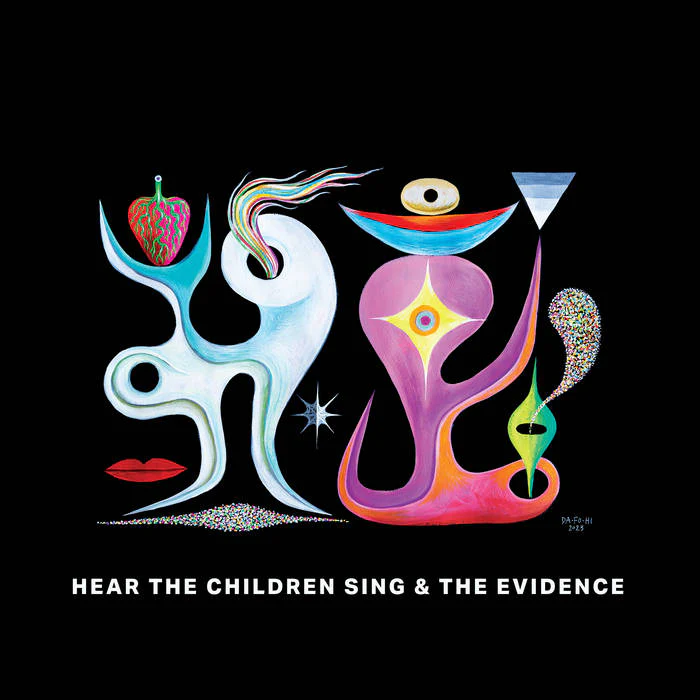
BONNIE "PRINCE" BILLY / NATHAN SALSBURG / TYLER TROTTER - Hear The Children Sing & The Evidence LP
When Nathan Salsburg’s daughter Talya was a baby, he often sang her to sleep in a rocking chair. At one point, he remembered a song he had taught himself as a teenager: “The Evidence” by Lungfish, the Maryland band who coined a singular brand of post-punk in the 90s and 00s. Salsburg realized he could play the guitar part with one hand, singing while holding Talya in his other arm. Though the original version of “The Evidence” is only five minutes long, it’s essentially a repetitive mantra, so Salsburg could extend it as long as he wanted–10 minutes, 20 minutes, even an hour. “It was therapeutic and calming and just lovely for me,” he says. “And it worked on her.”
Eventually Nathan and Talya moved on from their ritual, but his lullaby cover stayed in his head. “I find that lullabies stick more than anything else,” he says. “Something about the liminal space between awake and asleep, and the way that they ease into the subconsciousness.” So he proposed to his fellow Louisville collaborators Bonnie “Prince” Billy (aka Will Oldham) and Tyler Trotter that they record a version with Salsburg on guitar, Oldham singing, and Trotter adding drum machines and synths. They decided to pair it with a rendition of another Lungfish song, “Hear the Children Sing,” playing each tune for more than enough time to fill two sides of an album.
The result is the beguiling Hear the Children Sing the Evidence, an album that displays the strengths and visions of the participants while showcasing how richly powerful Lungfish’s songs are. “Hear the Children Sing” was recorded at the studio of Jim Marlowe, and features banjo contributions from Zak Riles (Trotter’s bandmate in Watter); “The Evidence” was recorded by Riles at his own space (just down the road from where Oldham made the Bonnie “Prince” Billy classic I See A Darkness) and includes some beautiful electric guitar from Will’s brother Ned.
There’s a liveness to the recordings that comes perhaps from the fact that the tracks were made without full group rehearsals in advance. “That's the approach that I appreciate,” Oldham explains. “Going into the studio and recording the interaction between musicians rather than recording their studied entries and exits.” On “Hear the Children Sing,” Salsburg’s delicate guitars and Oldham’s malleable voice weave around Trotter’s slow, steady drumbeat, accented by wisps of Riles’ banjo. Meanwhile, the drum-less “The Evidence” is an instant trance, with Salsburg’s acoustic guitar loop and Rhodes keyboard tones rhyming with Oldham’s short, deliberate lines.
For Oldham and Salsburg, doing extended versions of these originally-short songs uncovered a lot about Lungfish–especially the lyrics of Daniel Higgs, who can infuse a phrase as simple as “Oh the devil is a flower / Plucked from a cloud” with infinite meanings. “Each time through a single word might all of a sudden blossom,” says Oldham. “He puts things together with intentionality, so the more you embody them, the more they reveal and reward.” As a result, as Salsburg says, “The words are constantly unfolding with every listen.”
“Daniel has a grasp of language and its place in the quiver of communication tools and weapons, and understands that it's an incomplete thing,” Oldham continues. “So the words are there individually for us to plug into our brain or savor in the moment, but then every once in a while something gurgles up where you can visualize it or apply it to something in your life right now.” “That’s the core of mysticism,” adds Salsburg. “The individual mystic’s subjective representation of transcendent experience…. I wasn't thinking about what [Higgs’] lyrics meant when I was 14, but I knew I was listening to something profound. I guess it was the first mystical music I ever experienced.”
So perhaps mystical songs for adults and lullabies for children are one and the same. Making Hear the Children Sing the Evidence certainly brought the two together for Salsburg and Oldham, as well as their children. Halfway through “Hear the Children Sing,” Oldham’s daughter Poppy shares a chorus with her dad, and in the end, she and Talya become stars of the show. “It felt good to be a part of this endeavor, having our children exposed to this material that we've been working on,” says Oldham. “I’m excited that my own relationship to music from childhood is still with me, and arming our children and potentially other children who hear this, and adults of course, with that kind of an arsenal of words and ideas is really exciting. When my daughter sits in the backseat of the car singing, ‘Oh the devil is a flower…’–I just think that's gonna be worth something to her.”
When Nathan Salsburg’s daughter Talya was a baby, he often sang her to sleep in a rocking chair. At one point, he remembered a song he had taught himself as a teenager: “The Evidence” by Lungfish, the Maryland band who coined a singular brand of post-punk in the 90s and 00s. Salsburg realized he could play the guitar part with one hand, singing while holding Talya in his other arm. Though the original version of “The Evidence” is only five minutes long, it’s essentially a repetitive mantra, so Salsburg could extend it as long as he wanted–10 minutes, 20 minutes, even an hour. “It was therapeutic and calming and just lovely for me,” he says. “And it worked on her.”
Eventually Nathan and Talya moved on from their ritual, but his lullaby cover stayed in his head. “I find that lullabies stick more than anything else,” he says. “Something about the liminal space between awake and asleep, and the way that they ease into the subconsciousness.” So he proposed to his fellow Louisville collaborators Bonnie “Prince” Billy (aka Will Oldham) and Tyler Trotter that they record a version with Salsburg on guitar, Oldham singing, and Trotter adding drum machines and synths. They decided to pair it with a rendition of another Lungfish song, “Hear the Children Sing,” playing each tune for more than enough time to fill two sides of an album.
The result is the beguiling Hear the Children Sing the Evidence, an album that displays the strengths and visions of the participants while showcasing how richly powerful Lungfish’s songs are. “Hear the Children Sing” was recorded at the studio of Jim Marlowe, and features banjo contributions from Zak Riles (Trotter’s bandmate in Watter); “The Evidence” was recorded by Riles at his own space (just down the road from where Oldham made the Bonnie “Prince” Billy classic I See A Darkness) and includes some beautiful electric guitar from Will’s brother Ned.
There’s a liveness to the recordings that comes perhaps from the fact that the tracks were made without full group rehearsals in advance. “That's the approach that I appreciate,” Oldham explains. “Going into the studio and recording the interaction between musicians rather than recording their studied entries and exits.” On “Hear the Children Sing,” Salsburg’s delicate guitars and Oldham’s malleable voice weave around Trotter’s slow, steady drumbeat, accented by wisps of Riles’ banjo. Meanwhile, the drum-less “The Evidence” is an instant trance, with Salsburg’s acoustic guitar loop and Rhodes keyboard tones rhyming with Oldham’s short, deliberate lines.
For Oldham and Salsburg, doing extended versions of these originally-short songs uncovered a lot about Lungfish–especially the lyrics of Daniel Higgs, who can infuse a phrase as simple as “Oh the devil is a flower / Plucked from a cloud” with infinite meanings. “Each time through a single word might all of a sudden blossom,” says Oldham. “He puts things together with intentionality, so the more you embody them, the more they reveal and reward.” As a result, as Salsburg says, “The words are constantly unfolding with every listen.”
“Daniel has a grasp of language and its place in the quiver of communication tools and weapons, and understands that it's an incomplete thing,” Oldham continues. “So the words are there individually for us to plug into our brain or savor in the moment, but then every once in a while something gurgles up where you can visualize it or apply it to something in your life right now.” “That’s the core of mysticism,” adds Salsburg. “The individual mystic’s subjective representation of transcendent experience…. I wasn't thinking about what [Higgs’] lyrics meant when I was 14, but I knew I was listening to something profound. I guess it was the first mystical music I ever experienced.”
So perhaps mystical songs for adults and lullabies for children are one and the same. Making Hear the Children Sing the Evidence certainly brought the two together for Salsburg and Oldham, as well as their children. Halfway through “Hear the Children Sing,” Oldham’s daughter Poppy shares a chorus with her dad, and in the end, she and Talya become stars of the show. “It felt good to be a part of this endeavor, having our children exposed to this material that we've been working on,” says Oldham. “I’m excited that my own relationship to music from childhood is still with me, and arming our children and potentially other children who hear this, and adults of course, with that kind of an arsenal of words and ideas is really exciting. When my daughter sits in the backseat of the car singing, ‘Oh the devil is a flower…’–I just think that's gonna be worth something to her.”
Original: $32.41
-70%$32.41
$9.72Description
When Nathan Salsburg’s daughter Talya was a baby, he often sang her to sleep in a rocking chair. At one point, he remembered a song he had taught himself as a teenager: “The Evidence” by Lungfish, the Maryland band who coined a singular brand of post-punk in the 90s and 00s. Salsburg realized he could play the guitar part with one hand, singing while holding Talya in his other arm. Though the original version of “The Evidence” is only five minutes long, it’s essentially a repetitive mantra, so Salsburg could extend it as long as he wanted–10 minutes, 20 minutes, even an hour. “It was therapeutic and calming and just lovely for me,” he says. “And it worked on her.”
Eventually Nathan and Talya moved on from their ritual, but his lullaby cover stayed in his head. “I find that lullabies stick more than anything else,” he says. “Something about the liminal space between awake and asleep, and the way that they ease into the subconsciousness.” So he proposed to his fellow Louisville collaborators Bonnie “Prince” Billy (aka Will Oldham) and Tyler Trotter that they record a version with Salsburg on guitar, Oldham singing, and Trotter adding drum machines and synths. They decided to pair it with a rendition of another Lungfish song, “Hear the Children Sing,” playing each tune for more than enough time to fill two sides of an album.
The result is the beguiling Hear the Children Sing the Evidence, an album that displays the strengths and visions of the participants while showcasing how richly powerful Lungfish’s songs are. “Hear the Children Sing” was recorded at the studio of Jim Marlowe, and features banjo contributions from Zak Riles (Trotter’s bandmate in Watter); “The Evidence” was recorded by Riles at his own space (just down the road from where Oldham made the Bonnie “Prince” Billy classic I See A Darkness) and includes some beautiful electric guitar from Will’s brother Ned.
There’s a liveness to the recordings that comes perhaps from the fact that the tracks were made without full group rehearsals in advance. “That's the approach that I appreciate,” Oldham explains. “Going into the studio and recording the interaction between musicians rather than recording their studied entries and exits.” On “Hear the Children Sing,” Salsburg’s delicate guitars and Oldham’s malleable voice weave around Trotter’s slow, steady drumbeat, accented by wisps of Riles’ banjo. Meanwhile, the drum-less “The Evidence” is an instant trance, with Salsburg’s acoustic guitar loop and Rhodes keyboard tones rhyming with Oldham’s short, deliberate lines.
For Oldham and Salsburg, doing extended versions of these originally-short songs uncovered a lot about Lungfish–especially the lyrics of Daniel Higgs, who can infuse a phrase as simple as “Oh the devil is a flower / Plucked from a cloud” with infinite meanings. “Each time through a single word might all of a sudden blossom,” says Oldham. “He puts things together with intentionality, so the more you embody them, the more they reveal and reward.” As a result, as Salsburg says, “The words are constantly unfolding with every listen.”
“Daniel has a grasp of language and its place in the quiver of communication tools and weapons, and understands that it's an incomplete thing,” Oldham continues. “So the words are there individually for us to plug into our brain or savor in the moment, but then every once in a while something gurgles up where you can visualize it or apply it to something in your life right now.” “That’s the core of mysticism,” adds Salsburg. “The individual mystic’s subjective representation of transcendent experience…. I wasn't thinking about what [Higgs’] lyrics meant when I was 14, but I knew I was listening to something profound. I guess it was the first mystical music I ever experienced.”
So perhaps mystical songs for adults and lullabies for children are one and the same. Making Hear the Children Sing the Evidence certainly brought the two together for Salsburg and Oldham, as well as their children. Halfway through “Hear the Children Sing,” Oldham’s daughter Poppy shares a chorus with her dad, and in the end, she and Talya become stars of the show. “It felt good to be a part of this endeavor, having our children exposed to this material that we've been working on,” says Oldham. “I’m excited that my own relationship to music from childhood is still with me, and arming our children and potentially other children who hear this, and adults of course, with that kind of an arsenal of words and ideas is really exciting. When my daughter sits in the backseat of the car singing, ‘Oh the devil is a flower…’–I just think that's gonna be worth something to her.”