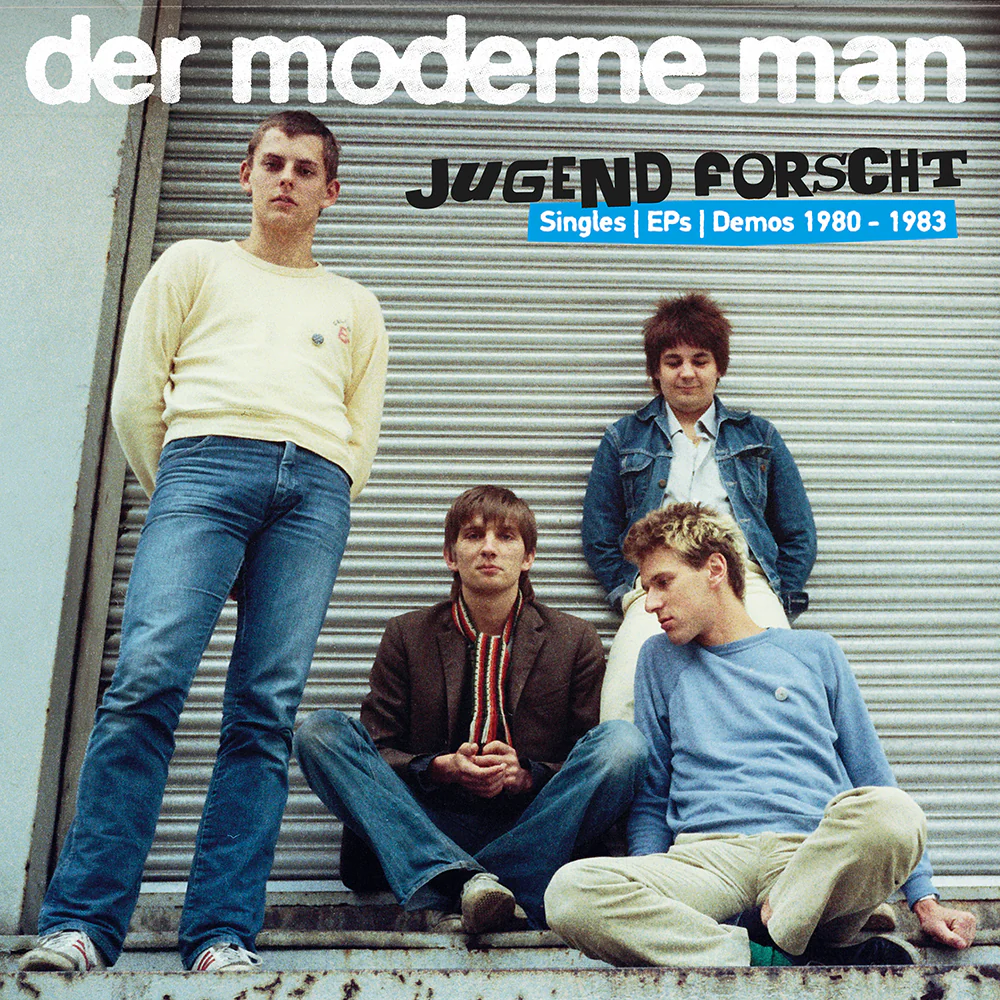
DER MODERNE MAN - Jugend Forscht: Singles, EPs, Demos 1980-1983 DLP
Der Moderne Man emerged from the vicinity of Hanover’s No Fun label, an incubator for a scene somewhere in between punk, avant-garde and new wave. In addition to two studio albums – which are currently also being re-issued – the band recorded various demos, EPs and singles between 1981 and 1983. These songs, which did not appear on the two regular albums, are now being re-issued for the first time as an independent compilation. “Jugend Forscht” spans an arc from the first EP to early demo recordings and a single that was never released as a regular album to the German-language New Wave of the last mini-LP ‘Neues aus Hong Kong’. The tracks collected on “Jugend Forscht” tell the story and development of Der Moderne Man in an impressive way. The compilation is supplemented by detailed liner notes and some never-before-published images.
Der Moderne Man combined a wide range of influences: the punk rock minimalism of guitarist Eckhardt ‘EKT’ Kurtz, English music magazines, imported records bought during visits to Berlin, the hyperactivity of drummer Claudius Hempelmann and the lyrics of Michael ‘Ziggy XY’ Jarick with their very own view of everyday life. In addition to the first EP, 1980 also saw the release of the LP ‘80 Tage auf See’, a new bass player and, at the end of the year, the departure of singer Ziggy XY, who wanted to dedicate himself to his own more consistently chaotic project Kosmonautentraum. In 1981, bass player Martin Simons became the new singer and Jens Gallmeyer from the kid punk group Phosphor amped up the punch and toned down more gothic elements, which was clearly audible on the single ‘Der Sandman’/‚Baggersee’.
After touring with five other bands from the No Fun label and new drummer Felix Wolter, Der Moderne Man released a live mini-LP and produced the LP ‘Unmodern’ with the additional band member Thomas ‘Tonio Scorpo’ Schnura on saxophone and synthesiser. Suffice it to say that „Unmodern“, i.e. non-modern, sounded like the opposite of its title. With the addition of bass player Axel Wicke, 1982 was shaped by numerous tours and positive to euphoric reviews. Soon, major record companies were coming along with offers, but the band (for the most part) rejected the industry’s temptations.
Der Moderne Man incorporated influences from England and the USA on their 1983 mini-LP ‘Neues aus Hong Kong’. This could have meant a career boost, but German audiences were tired out by the glut of cheap German new wave industry output and the band subsequently dropped out in autumn of that year.
The songs now compiled on ‘Jugend Forscht’ show that Hannover was capable of more than just rock music.
Der Moderne Man emerged from the vicinity of Hanover’s No Fun label, an incubator for a scene somewhere in between punk, avant-garde and new wave. In addition to two studio albums – which are currently also being re-issued – the band recorded various demos, EPs and singles between 1981 and 1983. These songs, which did not appear on the two regular albums, are now being re-issued for the first time as an independent compilation. “Jugend Forscht” spans an arc from the first EP to early demo recordings and a single that was never released as a regular album to the German-language New Wave of the last mini-LP ‘Neues aus Hong Kong’. The tracks collected on “Jugend Forscht” tell the story and development of Der Moderne Man in an impressive way. The compilation is supplemented by detailed liner notes and some never-before-published images.
Der Moderne Man combined a wide range of influences: the punk rock minimalism of guitarist Eckhardt ‘EKT’ Kurtz, English music magazines, imported records bought during visits to Berlin, the hyperactivity of drummer Claudius Hempelmann and the lyrics of Michael ‘Ziggy XY’ Jarick with their very own view of everyday life. In addition to the first EP, 1980 also saw the release of the LP ‘80 Tage auf See’, a new bass player and, at the end of the year, the departure of singer Ziggy XY, who wanted to dedicate himself to his own more consistently chaotic project Kosmonautentraum. In 1981, bass player Martin Simons became the new singer and Jens Gallmeyer from the kid punk group Phosphor amped up the punch and toned down more gothic elements, which was clearly audible on the single ‘Der Sandman’/‚Baggersee’.
After touring with five other bands from the No Fun label and new drummer Felix Wolter, Der Moderne Man released a live mini-LP and produced the LP ‘Unmodern’ with the additional band member Thomas ‘Tonio Scorpo’ Schnura on saxophone and synthesiser. Suffice it to say that „Unmodern“, i.e. non-modern, sounded like the opposite of its title. With the addition of bass player Axel Wicke, 1982 was shaped by numerous tours and positive to euphoric reviews. Soon, major record companies were coming along with offers, but the band (for the most part) rejected the industry’s temptations.
Der Moderne Man incorporated influences from England and the USA on their 1983 mini-LP ‘Neues aus Hong Kong’. This could have meant a career boost, but German audiences were tired out by the glut of cheap German new wave industry output and the band subsequently dropped out in autumn of that year.
The songs now compiled on ‘Jugend Forscht’ show that Hannover was capable of more than just rock music.
Original: $22,805.57
-70%$22,805.57
$6,841.67Description
Der Moderne Man emerged from the vicinity of Hanover’s No Fun label, an incubator for a scene somewhere in between punk, avant-garde and new wave. In addition to two studio albums – which are currently also being re-issued – the band recorded various demos, EPs and singles between 1981 and 1983. These songs, which did not appear on the two regular albums, are now being re-issued for the first time as an independent compilation. “Jugend Forscht” spans an arc from the first EP to early demo recordings and a single that was never released as a regular album to the German-language New Wave of the last mini-LP ‘Neues aus Hong Kong’. The tracks collected on “Jugend Forscht” tell the story and development of Der Moderne Man in an impressive way. The compilation is supplemented by detailed liner notes and some never-before-published images.
Der Moderne Man combined a wide range of influences: the punk rock minimalism of guitarist Eckhardt ‘EKT’ Kurtz, English music magazines, imported records bought during visits to Berlin, the hyperactivity of drummer Claudius Hempelmann and the lyrics of Michael ‘Ziggy XY’ Jarick with their very own view of everyday life. In addition to the first EP, 1980 also saw the release of the LP ‘80 Tage auf See’, a new bass player and, at the end of the year, the departure of singer Ziggy XY, who wanted to dedicate himself to his own more consistently chaotic project Kosmonautentraum. In 1981, bass player Martin Simons became the new singer and Jens Gallmeyer from the kid punk group Phosphor amped up the punch and toned down more gothic elements, which was clearly audible on the single ‘Der Sandman’/‚Baggersee’.
After touring with five other bands from the No Fun label and new drummer Felix Wolter, Der Moderne Man released a live mini-LP and produced the LP ‘Unmodern’ with the additional band member Thomas ‘Tonio Scorpo’ Schnura on saxophone and synthesiser. Suffice it to say that „Unmodern“, i.e. non-modern, sounded like the opposite of its title. With the addition of bass player Axel Wicke, 1982 was shaped by numerous tours and positive to euphoric reviews. Soon, major record companies were coming along with offers, but the band (for the most part) rejected the industry’s temptations.
Der Moderne Man incorporated influences from England and the USA on their 1983 mini-LP ‘Neues aus Hong Kong’. This could have meant a career boost, but German audiences were tired out by the glut of cheap German new wave industry output and the band subsequently dropped out in autumn of that year.
The songs now compiled on ‘Jugend Forscht’ show that Hannover was capable of more than just rock music.