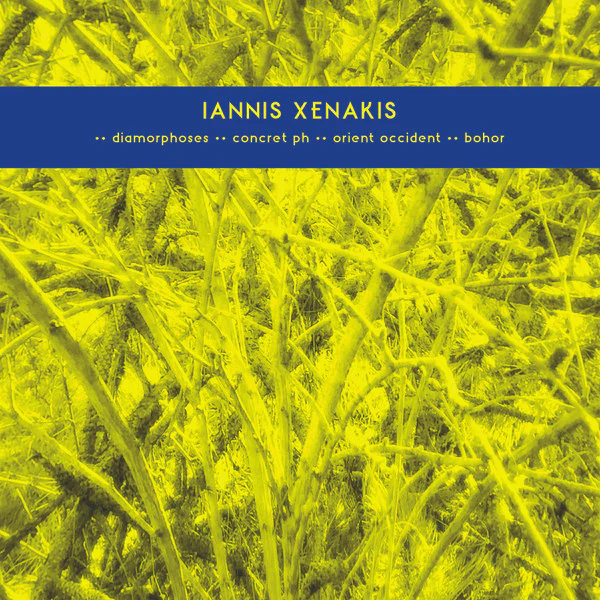
IANNIS XENAKIS - Diamorphoses / Concret Ph / Orient Occident / Bohor LP
Iannis Xenakis (1922-2001) is one of the most important composers of the 20th century avantgarde whose influence on music can be traced to the present day – not only in the world of conservatory-trained composers but also in various streams of current non-academic underground aesthetics such as experimental electronic music, noise and industrial. After he arrived in Paris in 1947, Xenakis not only studied composition with Messian and later became a member of the famous GRM (Groupe de recherches musicales).
His compositions often are based on mathematical principles which give his music an unprecedented aesthetic and “shocking otherness” (The Guardian).
Iannis Xenakis (1922-2001) is one of the most important composers of the 20th century avantgarde whose influence on music can be traced to the present day – not only in the world of conservatory-trained composers but also in various streams of current non-academic underground aesthetics such as experimental electronic music, noise and industrial. After he arrived in Paris in 1947, Xenakis not only studied composition with Messian and later became a member of the famous GRM (Groupe de recherches musicales).
His compositions often are based on mathematical principles which give his music an unprecedented aesthetic and “shocking otherness” (The Guardian).
Description
Iannis Xenakis (1922-2001) is one of the most important composers of the 20th century avantgarde whose influence on music can be traced to the present day – not only in the world of conservatory-trained composers but also in various streams of current non-academic underground aesthetics such as experimental electronic music, noise and industrial. After he arrived in Paris in 1947, Xenakis not only studied composition with Messian and later became a member of the famous GRM (Groupe de recherches musicales).
His compositions often are based on mathematical principles which give his music an unprecedented aesthetic and “shocking otherness” (The Guardian).