🚚 Kostenloser weltweiter Versand für alle Bestellungen!Jetzt einkaufen
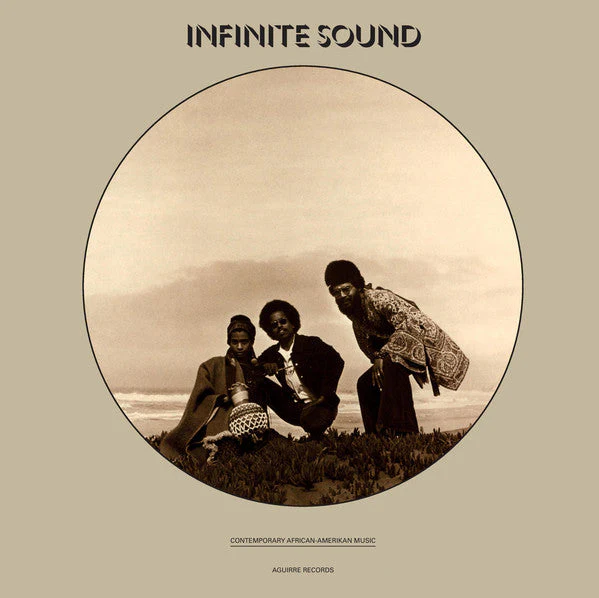
INFINITE SOUND - Contemporary African-Amerikan Music LP
Conscious avant-garde free jazz featuring Roland P. Young originally released in 1975 on the eclectical 1750 Arch records.
“1750 Arch was a beautiful Spanish-style hacienda,”recalls composer and multi-instrumentalist Roland P. Young. “It had a wonderful recording studio in the basement and the salon was converted into an intimate performance setting.” Young played solo gigs at that venue, in Berkeley, California, and also performed there in a duo with cellist Chris Chaffe. He remembers it as a particularly “transcendent” setting for concerts by Infinite Sound, his trio with singer Aisha Kahlil and bassist Glenn Howell.
Infinite Sound’s Contemporary African-Amerikan Music appeared in the uniquely diverse 1750 Arch catalogue in 1975. For Roland Young such a context was not incongruous. Contemporary African-Amerikan Music is a title that positioned the record quite specifically in 1975. But Young shares Buckner’s distaste for labels that fix expectations too rigidly and close down creative possibilities. Culturally and politically the early 70s appeared to Young to be a time of change and spiritual renewal. “There was a vibe in the air that we connected with, along with other kindred spirits world-wide. What appeared to be ‘experimental’ was reaching for sounds and emotions that were unfamiliar. We often performed at rallies in support of various causes: Black Liberation, Women’s Movement, Anti-War Movement, Gay Liberation. While the music came out of the Black Liberation struggle our ultimate goal was a blending of cultures.”
In 1968 Young was working as a DJ at KSAN, an underground rock station in San Francisco. “Glenn Howell used to call me when I was on air to comment about the music I was playing. He told me he was a musician and I invited him to come down to the station. We started to talk about music, then decided to get together and play. Young and Howell met Aisha Kahlil at one of their concerts. “A mutual friend introduced her and told us she was a good vocalist, loved our music and wanted to sing with us. We invited her to a rehearsal and soon after we invited her to join the group. Infinite Sound came together very easily and had a natural feel. We definitely had a shared intuition, and we created a lot of music. Each of us would bring ideas to rehearsals and we would work on them. Glenn tended to bring jazz tunes, Aisha tended to bring African-influenced compositions and I brought world, electronic, classical, jazz and avant garde material. Occasionally we would rearrange standards by composers like Duke Ellington and Charles Mingus. We talked a lot about how to present our material and how compositions would flow, one to the other. We were also conscious of how we dressed for performances, how we moved on stage, how we interacted with each other and the audience. We wanted it to be a ‘happening’. On occasion we would invite dancers to perform with us, friends of Aisha.”
Contemporary African-Amerikan Music preserves a fascinating glimpse of the trio in action. It testifies to the energy that Infinite Sound channelled into their music, but also to their imaginative breadth and expressive versatility.Their compositions embrace mobile forms, with Howell’s buoyantly springy and resilient bass taking on a strong pivotal role around which Young’s horns and Kahlil’s voice dance and spar and soar and play. Well-defined rhythms dissolve into textures; melodic shapes soften into shadings of timbre or flare into exuberant bursts of tonal colour. The music’s mood swings unpredictably from flamboyance to introspection; pacing shifts spontaneously from languor to urgency. Moments of musical allusiveness, sly quotation or stylistic reference, mutate into passages of wild inventiveness.
Tantalisingly this stimulating and varied set of pieces was this trio’s only release. Times have changed, yet increasingly in recent years creative artists have come to accept the need to erase musical boundaries and erode the constraints of aesthetic categorisation. Infinite Sound, and their enlightened host Tom Buckner, were decidedly ahead of the game.
- Julian Cowley
“1750 Arch was a beautiful Spanish-style hacienda,”recalls composer and multi-instrumentalist Roland P. Young. “It had a wonderful recording studio in the basement and the salon was converted into an intimate performance setting.” Young played solo gigs at that venue, in Berkeley, California, and also performed there in a duo with cellist Chris Chaffe. He remembers it as a particularly “transcendent” setting for concerts by Infinite Sound, his trio with singer Aisha Kahlil and bassist Glenn Howell.
Infinite Sound’s Contemporary African-Amerikan Music appeared in the uniquely diverse 1750 Arch catalogue in 1975. For Roland Young such a context was not incongruous. Contemporary African-Amerikan Music is a title that positioned the record quite specifically in 1975. But Young shares Buckner’s distaste for labels that fix expectations too rigidly and close down creative possibilities. Culturally and politically the early 70s appeared to Young to be a time of change and spiritual renewal. “There was a vibe in the air that we connected with, along with other kindred spirits world-wide. What appeared to be ‘experimental’ was reaching for sounds and emotions that were unfamiliar. We often performed at rallies in support of various causes: Black Liberation, Women’s Movement, Anti-War Movement, Gay Liberation. While the music came out of the Black Liberation struggle our ultimate goal was a blending of cultures.”
In 1968 Young was working as a DJ at KSAN, an underground rock station in San Francisco. “Glenn Howell used to call me when I was on air to comment about the music I was playing. He told me he was a musician and I invited him to come down to the station. We started to talk about music, then decided to get together and play. Young and Howell met Aisha Kahlil at one of their concerts. “A mutual friend introduced her and told us she was a good vocalist, loved our music and wanted to sing with us. We invited her to a rehearsal and soon after we invited her to join the group. Infinite Sound came together very easily and had a natural feel. We definitely had a shared intuition, and we created a lot of music. Each of us would bring ideas to rehearsals and we would work on them. Glenn tended to bring jazz tunes, Aisha tended to bring African-influenced compositions and I brought world, electronic, classical, jazz and avant garde material. Occasionally we would rearrange standards by composers like Duke Ellington and Charles Mingus. We talked a lot about how to present our material and how compositions would flow, one to the other. We were also conscious of how we dressed for performances, how we moved on stage, how we interacted with each other and the audience. We wanted it to be a ‘happening’. On occasion we would invite dancers to perform with us, friends of Aisha.”
Contemporary African-Amerikan Music preserves a fascinating glimpse of the trio in action. It testifies to the energy that Infinite Sound channelled into their music, but also to their imaginative breadth and expressive versatility.Their compositions embrace mobile forms, with Howell’s buoyantly springy and resilient bass taking on a strong pivotal role around which Young’s horns and Kahlil’s voice dance and spar and soar and play. Well-defined rhythms dissolve into textures; melodic shapes soften into shadings of timbre or flare into exuberant bursts of tonal colour. The music’s mood swings unpredictably from flamboyance to introspection; pacing shifts spontaneously from languor to urgency. Moments of musical allusiveness, sly quotation or stylistic reference, mutate into passages of wild inventiveness.
Tantalisingly this stimulating and varied set of pieces was this trio’s only release. Times have changed, yet increasingly in recent years creative artists have come to accept the need to erase musical boundaries and erode the constraints of aesthetic categorisation. Infinite Sound, and their enlightened host Tom Buckner, were decidedly ahead of the game.
- Julian Cowley
Conscious avant-garde free jazz featuring Roland P. Young originally released in 1975 on the eclectical 1750 Arch records.
“1750 Arch was a beautiful Spanish-style hacienda,”recalls composer and multi-instrumentalist Roland P. Young. “It had a wonderful recording studio in the basement and the salon was converted into an intimate performance setting.” Young played solo gigs at that venue, in Berkeley, California, and also performed there in a duo with cellist Chris Chaffe. He remembers it as a particularly “transcendent” setting for concerts by Infinite Sound, his trio with singer Aisha Kahlil and bassist Glenn Howell.
Infinite Sound’s Contemporary African-Amerikan Music appeared in the uniquely diverse 1750 Arch catalogue in 1975. For Roland Young such a context was not incongruous. Contemporary African-Amerikan Music is a title that positioned the record quite specifically in 1975. But Young shares Buckner’s distaste for labels that fix expectations too rigidly and close down creative possibilities. Culturally and politically the early 70s appeared to Young to be a time of change and spiritual renewal. “There was a vibe in the air that we connected with, along with other kindred spirits world-wide. What appeared to be ‘experimental’ was reaching for sounds and emotions that were unfamiliar. We often performed at rallies in support of various causes: Black Liberation, Women’s Movement, Anti-War Movement, Gay Liberation. While the music came out of the Black Liberation struggle our ultimate goal was a blending of cultures.”
In 1968 Young was working as a DJ at KSAN, an underground rock station in San Francisco. “Glenn Howell used to call me when I was on air to comment about the music I was playing. He told me he was a musician and I invited him to come down to the station. We started to talk about music, then decided to get together and play. Young and Howell met Aisha Kahlil at one of their concerts. “A mutual friend introduced her and told us she was a good vocalist, loved our music and wanted to sing with us. We invited her to a rehearsal and soon after we invited her to join the group. Infinite Sound came together very easily and had a natural feel. We definitely had a shared intuition, and we created a lot of music. Each of us would bring ideas to rehearsals and we would work on them. Glenn tended to bring jazz tunes, Aisha tended to bring African-influenced compositions and I brought world, electronic, classical, jazz and avant garde material. Occasionally we would rearrange standards by composers like Duke Ellington and Charles Mingus. We talked a lot about how to present our material and how compositions would flow, one to the other. We were also conscious of how we dressed for performances, how we moved on stage, how we interacted with each other and the audience. We wanted it to be a ‘happening’. On occasion we would invite dancers to perform with us, friends of Aisha.”
Contemporary African-Amerikan Music preserves a fascinating glimpse of the trio in action. It testifies to the energy that Infinite Sound channelled into their music, but also to their imaginative breadth and expressive versatility.Their compositions embrace mobile forms, with Howell’s buoyantly springy and resilient bass taking on a strong pivotal role around which Young’s horns and Kahlil’s voice dance and spar and soar and play. Well-defined rhythms dissolve into textures; melodic shapes soften into shadings of timbre or flare into exuberant bursts of tonal colour. The music’s mood swings unpredictably from flamboyance to introspection; pacing shifts spontaneously from languor to urgency. Moments of musical allusiveness, sly quotation or stylistic reference, mutate into passages of wild inventiveness.
Tantalisingly this stimulating and varied set of pieces was this trio’s only release. Times have changed, yet increasingly in recent years creative artists have come to accept the need to erase musical boundaries and erode the constraints of aesthetic categorisation. Infinite Sound, and their enlightened host Tom Buckner, were decidedly ahead of the game.
- Julian Cowley
“1750 Arch was a beautiful Spanish-style hacienda,”recalls composer and multi-instrumentalist Roland P. Young. “It had a wonderful recording studio in the basement and the salon was converted into an intimate performance setting.” Young played solo gigs at that venue, in Berkeley, California, and also performed there in a duo with cellist Chris Chaffe. He remembers it as a particularly “transcendent” setting for concerts by Infinite Sound, his trio with singer Aisha Kahlil and bassist Glenn Howell.
Infinite Sound’s Contemporary African-Amerikan Music appeared in the uniquely diverse 1750 Arch catalogue in 1975. For Roland Young such a context was not incongruous. Contemporary African-Amerikan Music is a title that positioned the record quite specifically in 1975. But Young shares Buckner’s distaste for labels that fix expectations too rigidly and close down creative possibilities. Culturally and politically the early 70s appeared to Young to be a time of change and spiritual renewal. “There was a vibe in the air that we connected with, along with other kindred spirits world-wide. What appeared to be ‘experimental’ was reaching for sounds and emotions that were unfamiliar. We often performed at rallies in support of various causes: Black Liberation, Women’s Movement, Anti-War Movement, Gay Liberation. While the music came out of the Black Liberation struggle our ultimate goal was a blending of cultures.”
In 1968 Young was working as a DJ at KSAN, an underground rock station in San Francisco. “Glenn Howell used to call me when I was on air to comment about the music I was playing. He told me he was a musician and I invited him to come down to the station. We started to talk about music, then decided to get together and play. Young and Howell met Aisha Kahlil at one of their concerts. “A mutual friend introduced her and told us she was a good vocalist, loved our music and wanted to sing with us. We invited her to a rehearsal and soon after we invited her to join the group. Infinite Sound came together very easily and had a natural feel. We definitely had a shared intuition, and we created a lot of music. Each of us would bring ideas to rehearsals and we would work on them. Glenn tended to bring jazz tunes, Aisha tended to bring African-influenced compositions and I brought world, electronic, classical, jazz and avant garde material. Occasionally we would rearrange standards by composers like Duke Ellington and Charles Mingus. We talked a lot about how to present our material and how compositions would flow, one to the other. We were also conscious of how we dressed for performances, how we moved on stage, how we interacted with each other and the audience. We wanted it to be a ‘happening’. On occasion we would invite dancers to perform with us, friends of Aisha.”
Contemporary African-Amerikan Music preserves a fascinating glimpse of the trio in action. It testifies to the energy that Infinite Sound channelled into their music, but also to their imaginative breadth and expressive versatility.Their compositions embrace mobile forms, with Howell’s buoyantly springy and resilient bass taking on a strong pivotal role around which Young’s horns and Kahlil’s voice dance and spar and soar and play. Well-defined rhythms dissolve into textures; melodic shapes soften into shadings of timbre or flare into exuberant bursts of tonal colour. The music’s mood swings unpredictably from flamboyance to introspection; pacing shifts spontaneously from languor to urgency. Moments of musical allusiveness, sly quotation or stylistic reference, mutate into passages of wild inventiveness.
Tantalisingly this stimulating and varied set of pieces was this trio’s only release. Times have changed, yet increasingly in recent years creative artists have come to accept the need to erase musical boundaries and erode the constraints of aesthetic categorisation. Infinite Sound, and their enlightened host Tom Buckner, were decidedly ahead of the game.
- Julian Cowley
$230.37
INFINITE SOUND - Contemporary African-Amerikan Music LP—
$230.37
Description
Conscious avant-garde free jazz featuring Roland P. Young originally released in 1975 on the eclectical 1750 Arch records.
“1750 Arch was a beautiful Spanish-style hacienda,”recalls composer and multi-instrumentalist Roland P. Young. “It had a wonderful recording studio in the basement and the salon was converted into an intimate performance setting.” Young played solo gigs at that venue, in Berkeley, California, and also performed there in a duo with cellist Chris Chaffe. He remembers it as a particularly “transcendent” setting for concerts by Infinite Sound, his trio with singer Aisha Kahlil and bassist Glenn Howell.
Infinite Sound’s Contemporary African-Amerikan Music appeared in the uniquely diverse 1750 Arch catalogue in 1975. For Roland Young such a context was not incongruous. Contemporary African-Amerikan Music is a title that positioned the record quite specifically in 1975. But Young shares Buckner’s distaste for labels that fix expectations too rigidly and close down creative possibilities. Culturally and politically the early 70s appeared to Young to be a time of change and spiritual renewal. “There was a vibe in the air that we connected with, along with other kindred spirits world-wide. What appeared to be ‘experimental’ was reaching for sounds and emotions that were unfamiliar. We often performed at rallies in support of various causes: Black Liberation, Women’s Movement, Anti-War Movement, Gay Liberation. While the music came out of the Black Liberation struggle our ultimate goal was a blending of cultures.”
In 1968 Young was working as a DJ at KSAN, an underground rock station in San Francisco. “Glenn Howell used to call me when I was on air to comment about the music I was playing. He told me he was a musician and I invited him to come down to the station. We started to talk about music, then decided to get together and play. Young and Howell met Aisha Kahlil at one of their concerts. “A mutual friend introduced her and told us she was a good vocalist, loved our music and wanted to sing with us. We invited her to a rehearsal and soon after we invited her to join the group. Infinite Sound came together very easily and had a natural feel. We definitely had a shared intuition, and we created a lot of music. Each of us would bring ideas to rehearsals and we would work on them. Glenn tended to bring jazz tunes, Aisha tended to bring African-influenced compositions and I brought world, electronic, classical, jazz and avant garde material. Occasionally we would rearrange standards by composers like Duke Ellington and Charles Mingus. We talked a lot about how to present our material and how compositions would flow, one to the other. We were also conscious of how we dressed for performances, how we moved on stage, how we interacted with each other and the audience. We wanted it to be a ‘happening’. On occasion we would invite dancers to perform with us, friends of Aisha.”
Contemporary African-Amerikan Music preserves a fascinating glimpse of the trio in action. It testifies to the energy that Infinite Sound channelled into their music, but also to their imaginative breadth and expressive versatility.Their compositions embrace mobile forms, with Howell’s buoyantly springy and resilient bass taking on a strong pivotal role around which Young’s horns and Kahlil’s voice dance and spar and soar and play. Well-defined rhythms dissolve into textures; melodic shapes soften into shadings of timbre or flare into exuberant bursts of tonal colour. The music’s mood swings unpredictably from flamboyance to introspection; pacing shifts spontaneously from languor to urgency. Moments of musical allusiveness, sly quotation or stylistic reference, mutate into passages of wild inventiveness.
Tantalisingly this stimulating and varied set of pieces was this trio’s only release. Times have changed, yet increasingly in recent years creative artists have come to accept the need to erase musical boundaries and erode the constraints of aesthetic categorisation. Infinite Sound, and their enlightened host Tom Buckner, were decidedly ahead of the game.
- Julian Cowley
“1750 Arch was a beautiful Spanish-style hacienda,”recalls composer and multi-instrumentalist Roland P. Young. “It had a wonderful recording studio in the basement and the salon was converted into an intimate performance setting.” Young played solo gigs at that venue, in Berkeley, California, and also performed there in a duo with cellist Chris Chaffe. He remembers it as a particularly “transcendent” setting for concerts by Infinite Sound, his trio with singer Aisha Kahlil and bassist Glenn Howell.
Infinite Sound’s Contemporary African-Amerikan Music appeared in the uniquely diverse 1750 Arch catalogue in 1975. For Roland Young such a context was not incongruous. Contemporary African-Amerikan Music is a title that positioned the record quite specifically in 1975. But Young shares Buckner’s distaste for labels that fix expectations too rigidly and close down creative possibilities. Culturally and politically the early 70s appeared to Young to be a time of change and spiritual renewal. “There was a vibe in the air that we connected with, along with other kindred spirits world-wide. What appeared to be ‘experimental’ was reaching for sounds and emotions that were unfamiliar. We often performed at rallies in support of various causes: Black Liberation, Women’s Movement, Anti-War Movement, Gay Liberation. While the music came out of the Black Liberation struggle our ultimate goal was a blending of cultures.”
In 1968 Young was working as a DJ at KSAN, an underground rock station in San Francisco. “Glenn Howell used to call me when I was on air to comment about the music I was playing. He told me he was a musician and I invited him to come down to the station. We started to talk about music, then decided to get together and play. Young and Howell met Aisha Kahlil at one of their concerts. “A mutual friend introduced her and told us she was a good vocalist, loved our music and wanted to sing with us. We invited her to a rehearsal and soon after we invited her to join the group. Infinite Sound came together very easily and had a natural feel. We definitely had a shared intuition, and we created a lot of music. Each of us would bring ideas to rehearsals and we would work on them. Glenn tended to bring jazz tunes, Aisha tended to bring African-influenced compositions and I brought world, electronic, classical, jazz and avant garde material. Occasionally we would rearrange standards by composers like Duke Ellington and Charles Mingus. We talked a lot about how to present our material and how compositions would flow, one to the other. We were also conscious of how we dressed for performances, how we moved on stage, how we interacted with each other and the audience. We wanted it to be a ‘happening’. On occasion we would invite dancers to perform with us, friends of Aisha.”
Contemporary African-Amerikan Music preserves a fascinating glimpse of the trio in action. It testifies to the energy that Infinite Sound channelled into their music, but also to their imaginative breadth and expressive versatility.Their compositions embrace mobile forms, with Howell’s buoyantly springy and resilient bass taking on a strong pivotal role around which Young’s horns and Kahlil’s voice dance and spar and soar and play. Well-defined rhythms dissolve into textures; melodic shapes soften into shadings of timbre or flare into exuberant bursts of tonal colour. The music’s mood swings unpredictably from flamboyance to introspection; pacing shifts spontaneously from languor to urgency. Moments of musical allusiveness, sly quotation or stylistic reference, mutate into passages of wild inventiveness.
Tantalisingly this stimulating and varied set of pieces was this trio’s only release. Times have changed, yet increasingly in recent years creative artists have come to accept the need to erase musical boundaries and erode the constraints of aesthetic categorisation. Infinite Sound, and their enlightened host Tom Buckner, were decidedly ahead of the game.
- Julian Cowley