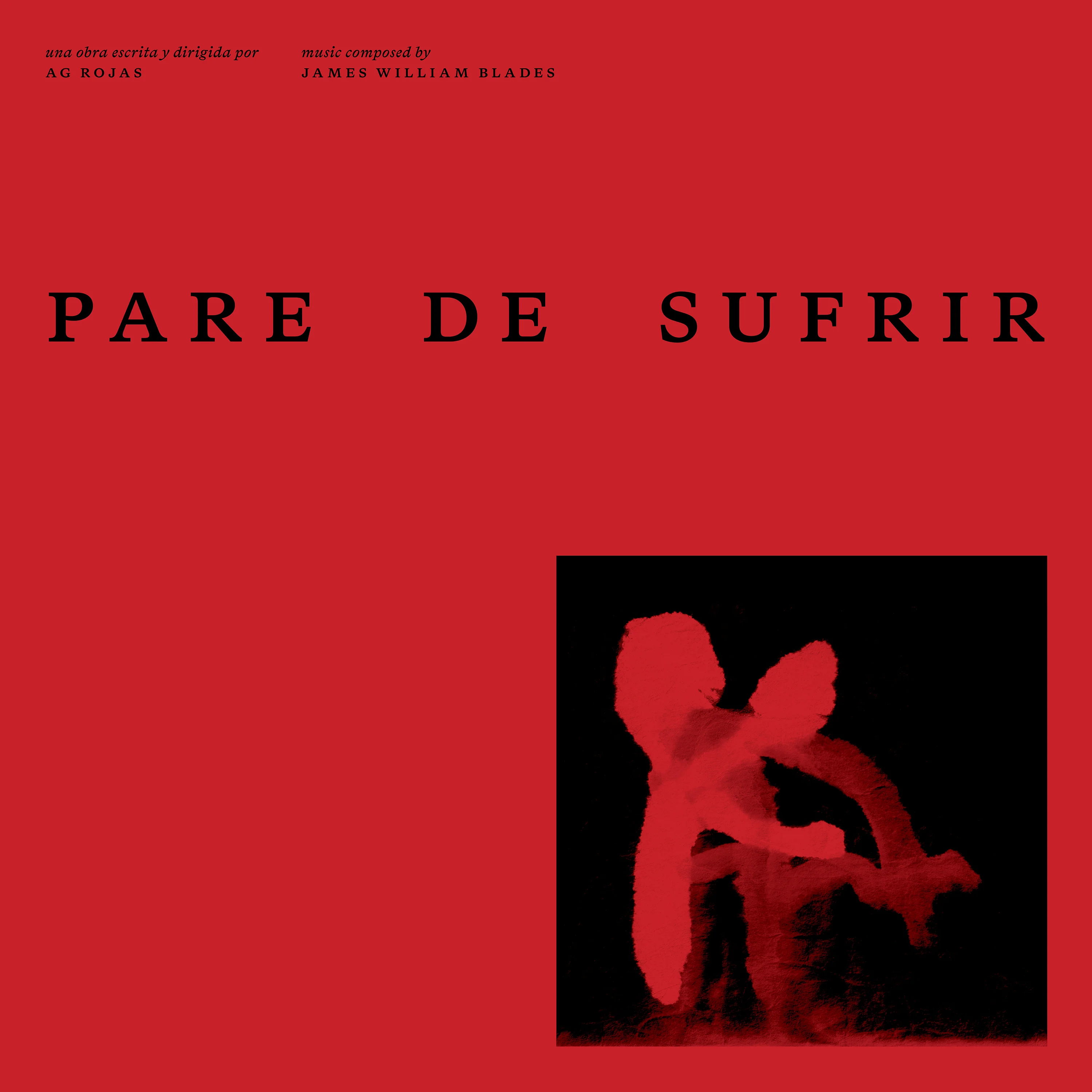
JAMES WILLIAM BLADES - Pare De Sufrir LP
Artist, composer and producer James William Blades’ score Pare De Sufrir will be released via AD 93.
Pare De Sufrir (translating to ‘End of Suffering’) is the official soundtrack to A.G Rojas’ film of the same title.
Spanish-born, Southern California-raised filmmaker AG Rojas is known for creating videos and working with the likes of Jamie xx, Gil Scott-Heron, Kamasi Washington, Spiritualized and Mitski. Rojas’ sensitive eye and subjectivity has brought him from the world of music videos to creating his first independent film: a 48-minute featurette following three people as they navigate the liminal space between life and the afterlife in an attempt to heal themselves and each other. Rojas’ film is a fragile, wordless meditation on grief and how it can transform and baptise the body and spirit.
The almost silent film is a testament to Rojas’ trust in Blades’ composition to express the director’s voice and emotions. Rojas reached out to Blades after coming across his score for Keeping Time (dir. Darol Olu Kae). An intimate and unusual process unfolded. Rojas explained to Blades the personal narrative of the film, the two sharing unfurling conversations on the nature of loss and the human spirit. But Blades did not watch the film and instead worked on instinct to build out a concept of how the score would unfold, shaping its operatic, textural and granular tone. Blades went on to record the score in full, with orchestra and choir, without going back to Rojas for feedback, aware that he was taking a complete risk. “It was definitely something I felt had a gravitational pull,” says Blades of the decision. The score’s pull is reflective of the process of grief itself, how its moods and memories oscillate up and down into the past and lost futures, Blades hitting all those spaces with diverse and stretching notes.
The piano holds the memories of Blades and Rojas’ grandmothers, who both had out-of-tune pianos sitting in an empty room. The Silogo-De-Oro choir sing throughout, reminiscent of the broken phonetics of grief, the build up and release of tension and the inability to articulate complete sound or words. The harmony stabilises and then becomes distant, taking the griever away from the lushness of life and into the realms of loss, death and dream-like realities, as mirrored in Rojas’ layered vignettes. As the score closes, the harmonies become richer and fuller, marking a return to life. Understanding the power of sound to both respond to and drive narrative, Blades’ score weaves together field recordings, half-remembered conversations, choral movements, string arrangements and electronic fragments into a nuanced and evocative whole.
________________________
James William Blades is a British composer and producer based in New York, whose work dissolves the boundaries between scores, sound design and music. Rooted in a meticulous sensitivity to melody and structure, he creates sonic landscapes that have the potential to refract meaning and tell new stories in the process.
It is through his multidisciplinary experience working with visual artists, directors, musicians and fashion designers that Blades has developed the unique musical aesthetic he is now bringing to the world of cinema. Blades began by collaborating with fashion designer Grace Wales Bonner, artist Theaster Gates, and film-maker Kahlil Joseph. Exploring the expressive possibilities of composition, his atmospheric sound collages for Joseph’s 2017 film Fly Paper and short film Process for the British music artist Sampha, subsequently led Blades to work with Beyoncé on Black is King for Disney in 2020, and more recently Renaissance, Beyonce’s self-directed documentary concert film.
Learning from visual artists, themselves reframing the relationship between music, sound and image, Blades has created a singular sonic language he describes in terms of landscape painting. “I like conveying a non-linear sense of sonics, playing around with combinations, depths, tempos, and making it feel like you’re in a moment surrounded. It’s visceral,” he explains. In each case, his approach involves periods of contextual and multi- instrumental research, working closely with directors to understand how best to support the specific emotions, moods and textures of the project at hand. “Thinking about the painting of a score is something that I'm trying to translate over a longer scale.”
This capacity to work on a variety of long-form projects is evident, whether in the scores he has had exhibited in a gallery context (Venice Biennale, Serpentine Gallery, 180 The Strand, Palais De Tokyo), or in the debut solo productions he is readying for release.
Other composer credits include Tendaberry, Hayley Elizabeth Anderson’s critically lauded debut feature film which premiered at Sundance 2024, the Showtime documentary NYC Point Gods produced by Coodie and Chike and Kevin Durant and Kiin a three part companion film directed by Fenn O’Meally and written by Letitia Wright and Tamara Lawrance.
A storyteller in the broadest sense of the word, Blades’ extensive inter-disciplinary experience marks him out as an artist in his own right, bringing an exciting and fresh approach to feature film composition.
Artist, composer and producer James William Blades’ score Pare De Sufrir will be released via AD 93.
Pare De Sufrir (translating to ‘End of Suffering’) is the official soundtrack to A.G Rojas’ film of the same title.
Spanish-born, Southern California-raised filmmaker AG Rojas is known for creating videos and working with the likes of Jamie xx, Gil Scott-Heron, Kamasi Washington, Spiritualized and Mitski. Rojas’ sensitive eye and subjectivity has brought him from the world of music videos to creating his first independent film: a 48-minute featurette following three people as they navigate the liminal space between life and the afterlife in an attempt to heal themselves and each other. Rojas’ film is a fragile, wordless meditation on grief and how it can transform and baptise the body and spirit.
The almost silent film is a testament to Rojas’ trust in Blades’ composition to express the director’s voice and emotions. Rojas reached out to Blades after coming across his score for Keeping Time (dir. Darol Olu Kae). An intimate and unusual process unfolded. Rojas explained to Blades the personal narrative of the film, the two sharing unfurling conversations on the nature of loss and the human spirit. But Blades did not watch the film and instead worked on instinct to build out a concept of how the score would unfold, shaping its operatic, textural and granular tone. Blades went on to record the score in full, with orchestra and choir, without going back to Rojas for feedback, aware that he was taking a complete risk. “It was definitely something I felt had a gravitational pull,” says Blades of the decision. The score’s pull is reflective of the process of grief itself, how its moods and memories oscillate up and down into the past and lost futures, Blades hitting all those spaces with diverse and stretching notes.
The piano holds the memories of Blades and Rojas’ grandmothers, who both had out-of-tune pianos sitting in an empty room. The Silogo-De-Oro choir sing throughout, reminiscent of the broken phonetics of grief, the build up and release of tension and the inability to articulate complete sound or words. The harmony stabilises and then becomes distant, taking the griever away from the lushness of life and into the realms of loss, death and dream-like realities, as mirrored in Rojas’ layered vignettes. As the score closes, the harmonies become richer and fuller, marking a return to life. Understanding the power of sound to both respond to and drive narrative, Blades’ score weaves together field recordings, half-remembered conversations, choral movements, string arrangements and electronic fragments into a nuanced and evocative whole.
________________________
James William Blades is a British composer and producer based in New York, whose work dissolves the boundaries between scores, sound design and music. Rooted in a meticulous sensitivity to melody and structure, he creates sonic landscapes that have the potential to refract meaning and tell new stories in the process.
It is through his multidisciplinary experience working with visual artists, directors, musicians and fashion designers that Blades has developed the unique musical aesthetic he is now bringing to the world of cinema. Blades began by collaborating with fashion designer Grace Wales Bonner, artist Theaster Gates, and film-maker Kahlil Joseph. Exploring the expressive possibilities of composition, his atmospheric sound collages for Joseph’s 2017 film Fly Paper and short film Process for the British music artist Sampha, subsequently led Blades to work with Beyoncé on Black is King for Disney in 2020, and more recently Renaissance, Beyonce’s self-directed documentary concert film.
Learning from visual artists, themselves reframing the relationship between music, sound and image, Blades has created a singular sonic language he describes in terms of landscape painting. “I like conveying a non-linear sense of sonics, playing around with combinations, depths, tempos, and making it feel like you’re in a moment surrounded. It’s visceral,” he explains. In each case, his approach involves periods of contextual and multi- instrumental research, working closely with directors to understand how best to support the specific emotions, moods and textures of the project at hand. “Thinking about the painting of a score is something that I'm trying to translate over a longer scale.”
This capacity to work on a variety of long-form projects is evident, whether in the scores he has had exhibited in a gallery context (Venice Biennale, Serpentine Gallery, 180 The Strand, Palais De Tokyo), or in the debut solo productions he is readying for release.
Other composer credits include Tendaberry, Hayley Elizabeth Anderson’s critically lauded debut feature film which premiered at Sundance 2024, the Showtime documentary NYC Point Gods produced by Coodie and Chike and Kevin Durant and Kiin a three part companion film directed by Fenn O’Meally and written by Letitia Wright and Tamara Lawrance.
A storyteller in the broadest sense of the word, Blades’ extensive inter-disciplinary experience marks him out as an artist in his own right, bringing an exciting and fresh approach to feature film composition.
Original: $635.55
-70%$635.55
$190.66Description
Artist, composer and producer James William Blades’ score Pare De Sufrir will be released via AD 93.
Pare De Sufrir (translating to ‘End of Suffering’) is the official soundtrack to A.G Rojas’ film of the same title.
Spanish-born, Southern California-raised filmmaker AG Rojas is known for creating videos and working with the likes of Jamie xx, Gil Scott-Heron, Kamasi Washington, Spiritualized and Mitski. Rojas’ sensitive eye and subjectivity has brought him from the world of music videos to creating his first independent film: a 48-minute featurette following three people as they navigate the liminal space between life and the afterlife in an attempt to heal themselves and each other. Rojas’ film is a fragile, wordless meditation on grief and how it can transform and baptise the body and spirit.
The almost silent film is a testament to Rojas’ trust in Blades’ composition to express the director’s voice and emotions. Rojas reached out to Blades after coming across his score for Keeping Time (dir. Darol Olu Kae). An intimate and unusual process unfolded. Rojas explained to Blades the personal narrative of the film, the two sharing unfurling conversations on the nature of loss and the human spirit. But Blades did not watch the film and instead worked on instinct to build out a concept of how the score would unfold, shaping its operatic, textural and granular tone. Blades went on to record the score in full, with orchestra and choir, without going back to Rojas for feedback, aware that he was taking a complete risk. “It was definitely something I felt had a gravitational pull,” says Blades of the decision. The score’s pull is reflective of the process of grief itself, how its moods and memories oscillate up and down into the past and lost futures, Blades hitting all those spaces with diverse and stretching notes.
The piano holds the memories of Blades and Rojas’ grandmothers, who both had out-of-tune pianos sitting in an empty room. The Silogo-De-Oro choir sing throughout, reminiscent of the broken phonetics of grief, the build up and release of tension and the inability to articulate complete sound or words. The harmony stabilises and then becomes distant, taking the griever away from the lushness of life and into the realms of loss, death and dream-like realities, as mirrored in Rojas’ layered vignettes. As the score closes, the harmonies become richer and fuller, marking a return to life. Understanding the power of sound to both respond to and drive narrative, Blades’ score weaves together field recordings, half-remembered conversations, choral movements, string arrangements and electronic fragments into a nuanced and evocative whole.
________________________
James William Blades is a British composer and producer based in New York, whose work dissolves the boundaries between scores, sound design and music. Rooted in a meticulous sensitivity to melody and structure, he creates sonic landscapes that have the potential to refract meaning and tell new stories in the process.
It is through his multidisciplinary experience working with visual artists, directors, musicians and fashion designers that Blades has developed the unique musical aesthetic he is now bringing to the world of cinema. Blades began by collaborating with fashion designer Grace Wales Bonner, artist Theaster Gates, and film-maker Kahlil Joseph. Exploring the expressive possibilities of composition, his atmospheric sound collages for Joseph’s 2017 film Fly Paper and short film Process for the British music artist Sampha, subsequently led Blades to work with Beyoncé on Black is King for Disney in 2020, and more recently Renaissance, Beyonce’s self-directed documentary concert film.
Learning from visual artists, themselves reframing the relationship between music, sound and image, Blades has created a singular sonic language he describes in terms of landscape painting. “I like conveying a non-linear sense of sonics, playing around with combinations, depths, tempos, and making it feel like you’re in a moment surrounded. It’s visceral,” he explains. In each case, his approach involves periods of contextual and multi- instrumental research, working closely with directors to understand how best to support the specific emotions, moods and textures of the project at hand. “Thinking about the painting of a score is something that I'm trying to translate over a longer scale.”
This capacity to work on a variety of long-form projects is evident, whether in the scores he has had exhibited in a gallery context (Venice Biennale, Serpentine Gallery, 180 The Strand, Palais De Tokyo), or in the debut solo productions he is readying for release.
Other composer credits include Tendaberry, Hayley Elizabeth Anderson’s critically lauded debut feature film which premiered at Sundance 2024, the Showtime documentary NYC Point Gods produced by Coodie and Chike and Kevin Durant and Kiin a three part companion film directed by Fenn O’Meally and written by Letitia Wright and Tamara Lawrance.
A storyteller in the broadest sense of the word, Blades’ extensive inter-disciplinary experience marks him out as an artist in his own right, bringing an exciting and fresh approach to feature film composition.