MARINA ROSENFELD - Deathstar DLP
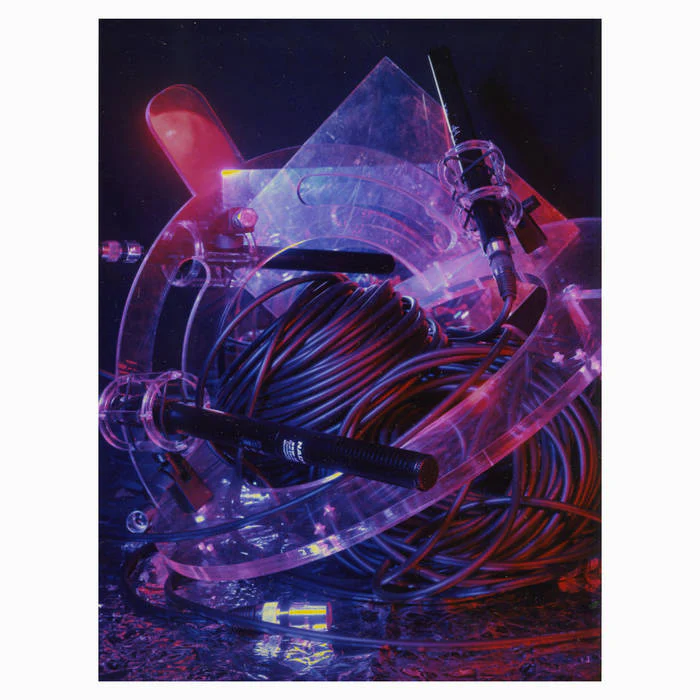
Since 2017, Deathstar has been a project about the microphone — in Marina Rosenfeld’s hands, a void, a mirror, an unruly instrument of transformation and mediation. This music is heard in traces, through thickly amplified silences punctuated by momentary eruptions of noise or a voice at the threshold of intelligibility. The sculpture at the center of the action—a plexiglas orb housing a 7-microphone array originally installed as part of an exhibition the artist mounted at Portikus, in Frankfurt Germany— performs a recursive operation, listening to and recirculating sounds continuously morphed by feedback and reflection. This machine music repeats itself in seemingly endless versions, abstractly and in an evolving relationship to the grammars of reproduction and performance, presence, absence, and accumulation. Later, recorded traces of this installation rendered as musical notation produce a series of events—concerts that explore the outcomes of the acts of amplifying, writing, and listening.
The four sides of the album Deathstar follow four such events: first, the installation of the Deathstar in exhibition space; then, a piano performance, also within the Deathstar’s machinic environment, of a recording of the installation that Rosenfeld notated on paper; then, her re-notation of these recorded traces in the form of a concerto for piano and chamber orchestra, all aggressively amplified through a wall of guitar amps; and finally, the orchestration’s reduction to something like chamber music, with acoustic instruments tasked with the representation of an ever more attenuated body of traces. Throughout, the extraordinary virtuoso pianist Marino Formenti and ensembles MusikFabrik (Cologne) and Yarn/Wire (New York) extract a dazzling variety of sounds from their readings of the work’s written and acoustic forms. Deathstar is a complex and monumental work from a composer who has long explored the limits of form as an artist and as a listener.
Since 2017, Deathstar has been a project about the microphone — in Marina Rosenfeld’s hands, a void, a mirror, an unruly instrument of transformation and mediation. This music is heard in traces, through thickly amplified silences punctuated by momentary eruptions of noise or a voice at the threshold of intelligibility. The sculpture at the center of the action—a plexiglas orb housing a 7-microphone array originally installed as part of an exhibition the artist mounted at Portikus, in Frankfurt Germany— performs a recursive operation, listening to and recirculating sounds continuously morphed by feedback and reflection. This machine music repeats itself in seemingly endless versions, abstractly and in an evolving relationship to the grammars of reproduction and performance, presence, absence, and accumulation. Later, recorded traces of this installation rendered as musical notation produce a series of events—concerts that explore the outcomes of the acts of amplifying, writing, and listening.
The four sides of the album Deathstar follow four such events: first, the installation of the Deathstar in exhibition space; then, a piano performance, also within the Deathstar’s machinic environment, of a recording of the installation that Rosenfeld notated on paper; then, her re-notation of these recorded traces in the form of a concerto for piano and chamber orchestra, all aggressively amplified through a wall of guitar amps; and finally, the orchestration’s reduction to something like chamber music, with acoustic instruments tasked with the representation of an ever more attenuated body of traces. Throughout, the extraordinary virtuoso pianist Marino Formenti and ensembles MusikFabrik (Cologne) and Yarn/Wire (New York) extract a dazzling variety of sounds from their readings of the work’s written and acoustic forms. Deathstar is a complex and monumental work from a composer who has long explored the limits of form as an artist and as a listener.
Original: $37.04
-70%$37.04
$11.11Description
Since 2017, Deathstar has been a project about the microphone — in Marina Rosenfeld’s hands, a void, a mirror, an unruly instrument of transformation and mediation. This music is heard in traces, through thickly amplified silences punctuated by momentary eruptions of noise or a voice at the threshold of intelligibility. The sculpture at the center of the action—a plexiglas orb housing a 7-microphone array originally installed as part of an exhibition the artist mounted at Portikus, in Frankfurt Germany— performs a recursive operation, listening to and recirculating sounds continuously morphed by feedback and reflection. This machine music repeats itself in seemingly endless versions, abstractly and in an evolving relationship to the grammars of reproduction and performance, presence, absence, and accumulation. Later, recorded traces of this installation rendered as musical notation produce a series of events—concerts that explore the outcomes of the acts of amplifying, writing, and listening.
The four sides of the album Deathstar follow four such events: first, the installation of the Deathstar in exhibition space; then, a piano performance, also within the Deathstar’s machinic environment, of a recording of the installation that Rosenfeld notated on paper; then, her re-notation of these recorded traces in the form of a concerto for piano and chamber orchestra, all aggressively amplified through a wall of guitar amps; and finally, the orchestration’s reduction to something like chamber music, with acoustic instruments tasked with the representation of an ever more attenuated body of traces. Throughout, the extraordinary virtuoso pianist Marino Formenti and ensembles MusikFabrik (Cologne) and Yarn/Wire (New York) extract a dazzling variety of sounds from their readings of the work’s written and acoustic forms. Deathstar is a complex and monumental work from a composer who has long explored the limits of form as an artist and as a listener.