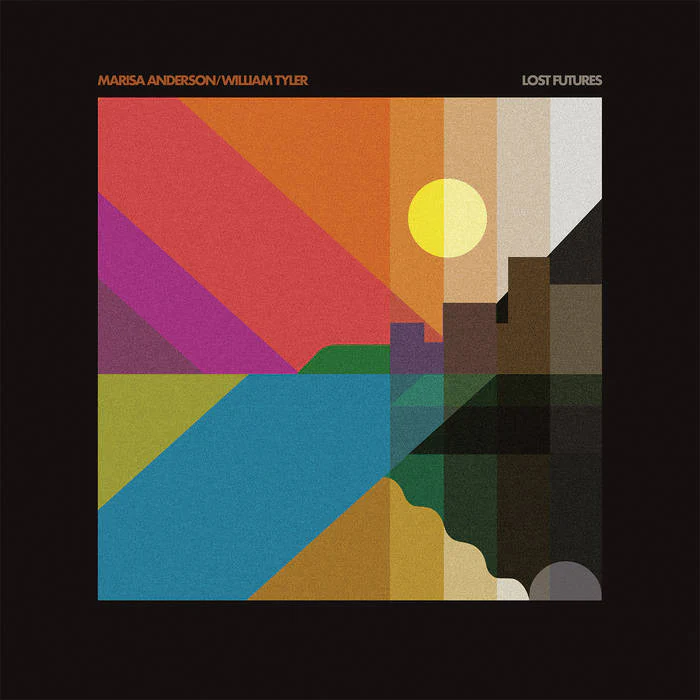
MARISA ANDERSON & WILLIAM TYLER - Lost Futures LP
Colored Vinyl.
Guitarists Marisa Anderson and William Tyler distill deeply rooted and varied traditions into distinctive voices all their own. Anderson and Tyler are each unyielding in their desire to extend through those traditions and the confines of “guitar music” to craft music at once intimate and expansive, conversational and transcendent. The duo’s debut collaborative album tethers together their singular voices into unified narratives that glisten, drive, and sway. On Lost Futures, Anderson and Tyler’s guitars dance through lush arrangements and pastoral duets serpentine and reverent.
The kindred musicians first collaborated in the days following a Portland show commemorating the life of the late David Berman. As Anderson tells it, “There was an obvious and immediate affinity musically and personally which led to the feeling that we should try and do something together, but in January of 2020, both of us had pretty full schedules so it was more of a vague idea to do something, someday… then COVID hit.” With tours sidelined and the increasing tensions of isolation, unrest and ecological disaster looming, the duo set to composing and collaborating remotely. Tyler joined Anderson in Portland for a week before recording as protests across the city escalated and raging wildfires cast a dangerous haze. Against the tumultuous backdrop the duo found harmony in their quick, organic development as a compositional team. Rich ballads and breezy rambles flourished as the duo explored new rhythmic techniques and elaborated on unused riffs. In uniting to meditate on their musical practices together, the two guitarists composed music filled with the joy of playing together while having a sober tone reflective of the troubled state of the world around them.
Lost Futures takes its name from writer Mark Fisher’s cultural theory of the loss of potential futures, the hopes and ideals which once felt inevitable but have since been interrupted. Anderson and Tyler’s use of textural drones, rhythmic repetition and harmonic shifts embody the building tensions of uncertainty created by profound loss: loss of life, experience, companionship, compassion. “For every choice made, every path taken, there are multitudes of choices not made, paths not taken,” notes Anderson. “At the Edge of the World” manifests the energy of perpetual momentum through string player Gisela Rodriguez Fernandez’s staccato jabs and the clicking scrapes of patricia vázquez gómez’s quijada. The unison melody of “Pray For Rain” sounds as a chorus collectively asking when relief will come. A drone-via-repetition on “Something Will Come'' invokes a sonic mirage that suspends reality as subtle yet revelatory changes froth from beneath the haze. Still, hope and catharsis find a way to shine through the mire in the duo’s implementation of space and tonal balance. With title track “Lost Futures,” Anderson and Tyler’s lullabye-like counter melodies lace around one another with the gentle ease of a friendly embrace.
Across Lost Futures, Anderson and Tyler mold their instruments into breathtaking panoramas of blight and bliss. Each movement contains a dense biome of transportive sound. The duo’s music together reckons with mounting pressures as well as the joy of newfound friendship and gratitude for being able to play together. In tandem, Marisa Anderson and William Tyler have composed a work of remarkable breadth, brimming with resplendent odes of solace.
Colored Vinyl.
Guitarists Marisa Anderson and William Tyler distill deeply rooted and varied traditions into distinctive voices all their own. Anderson and Tyler are each unyielding in their desire to extend through those traditions and the confines of “guitar music” to craft music at once intimate and expansive, conversational and transcendent. The duo’s debut collaborative album tethers together their singular voices into unified narratives that glisten, drive, and sway. On Lost Futures, Anderson and Tyler’s guitars dance through lush arrangements and pastoral duets serpentine and reverent.
The kindred musicians first collaborated in the days following a Portland show commemorating the life of the late David Berman. As Anderson tells it, “There was an obvious and immediate affinity musically and personally which led to the feeling that we should try and do something together, but in January of 2020, both of us had pretty full schedules so it was more of a vague idea to do something, someday… then COVID hit.” With tours sidelined and the increasing tensions of isolation, unrest and ecological disaster looming, the duo set to composing and collaborating remotely. Tyler joined Anderson in Portland for a week before recording as protests across the city escalated and raging wildfires cast a dangerous haze. Against the tumultuous backdrop the duo found harmony in their quick, organic development as a compositional team. Rich ballads and breezy rambles flourished as the duo explored new rhythmic techniques and elaborated on unused riffs. In uniting to meditate on their musical practices together, the two guitarists composed music filled with the joy of playing together while having a sober tone reflective of the troubled state of the world around them.
Lost Futures takes its name from writer Mark Fisher’s cultural theory of the loss of potential futures, the hopes and ideals which once felt inevitable but have since been interrupted. Anderson and Tyler’s use of textural drones, rhythmic repetition and harmonic shifts embody the building tensions of uncertainty created by profound loss: loss of life, experience, companionship, compassion. “For every choice made, every path taken, there are multitudes of choices not made, paths not taken,” notes Anderson. “At the Edge of the World” manifests the energy of perpetual momentum through string player Gisela Rodriguez Fernandez’s staccato jabs and the clicking scrapes of patricia vázquez gómez’s quijada. The unison melody of “Pray For Rain” sounds as a chorus collectively asking when relief will come. A drone-via-repetition on “Something Will Come'' invokes a sonic mirage that suspends reality as subtle yet revelatory changes froth from beneath the haze. Still, hope and catharsis find a way to shine through the mire in the duo’s implementation of space and tonal balance. With title track “Lost Futures,” Anderson and Tyler’s lullabye-like counter melodies lace around one another with the gentle ease of a friendly embrace.
Across Lost Futures, Anderson and Tyler mold their instruments into breathtaking panoramas of blight and bliss. Each movement contains a dense biome of transportive sound. The duo’s music together reckons with mounting pressures as well as the joy of newfound friendship and gratitude for being able to play together. In tandem, Marisa Anderson and William Tyler have composed a work of remarkable breadth, brimming with resplendent odes of solace.
Description
Colored Vinyl.
Guitarists Marisa Anderson and William Tyler distill deeply rooted and varied traditions into distinctive voices all their own. Anderson and Tyler are each unyielding in their desire to extend through those traditions and the confines of “guitar music” to craft music at once intimate and expansive, conversational and transcendent. The duo’s debut collaborative album tethers together their singular voices into unified narratives that glisten, drive, and sway. On Lost Futures, Anderson and Tyler’s guitars dance through lush arrangements and pastoral duets serpentine and reverent.
The kindred musicians first collaborated in the days following a Portland show commemorating the life of the late David Berman. As Anderson tells it, “There was an obvious and immediate affinity musically and personally which led to the feeling that we should try and do something together, but in January of 2020, both of us had pretty full schedules so it was more of a vague idea to do something, someday… then COVID hit.” With tours sidelined and the increasing tensions of isolation, unrest and ecological disaster looming, the duo set to composing and collaborating remotely. Tyler joined Anderson in Portland for a week before recording as protests across the city escalated and raging wildfires cast a dangerous haze. Against the tumultuous backdrop the duo found harmony in their quick, organic development as a compositional team. Rich ballads and breezy rambles flourished as the duo explored new rhythmic techniques and elaborated on unused riffs. In uniting to meditate on their musical practices together, the two guitarists composed music filled with the joy of playing together while having a sober tone reflective of the troubled state of the world around them.
Lost Futures takes its name from writer Mark Fisher’s cultural theory of the loss of potential futures, the hopes and ideals which once felt inevitable but have since been interrupted. Anderson and Tyler’s use of textural drones, rhythmic repetition and harmonic shifts embody the building tensions of uncertainty created by profound loss: loss of life, experience, companionship, compassion. “For every choice made, every path taken, there are multitudes of choices not made, paths not taken,” notes Anderson. “At the Edge of the World” manifests the energy of perpetual momentum through string player Gisela Rodriguez Fernandez’s staccato jabs and the clicking scrapes of patricia vázquez gómez’s quijada. The unison melody of “Pray For Rain” sounds as a chorus collectively asking when relief will come. A drone-via-repetition on “Something Will Come'' invokes a sonic mirage that suspends reality as subtle yet revelatory changes froth from beneath the haze. Still, hope and catharsis find a way to shine through the mire in the duo’s implementation of space and tonal balance. With title track “Lost Futures,” Anderson and Tyler’s lullabye-like counter melodies lace around one another with the gentle ease of a friendly embrace.
Across Lost Futures, Anderson and Tyler mold their instruments into breathtaking panoramas of blight and bliss. Each movement contains a dense biome of transportive sound. The duo’s music together reckons with mounting pressures as well as the joy of newfound friendship and gratitude for being able to play together. In tandem, Marisa Anderson and William Tyler have composed a work of remarkable breadth, brimming with resplendent odes of solace.