🚚 Kostenloser weltweiter Versand für alle Bestellungen!Jetzt einkaufen
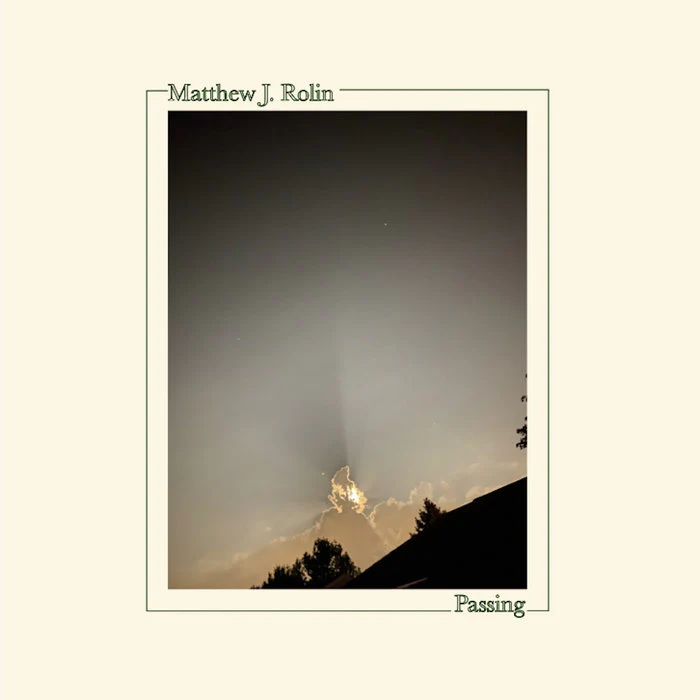
MATTHEW J. ROLIN - Passing LP
With a slew of full-length releases on some of the Western hemisphere’s sharpest labels for out, experimental or psychedelic music -- Astral Spirits, Feeding Tube, Worried Songs, Trouble in Mind -- Matthew J. Rolin has quietly established himself as one of America’s higher purveyors of guitar music. He’s often worked in collaboration with his wife, the librarian and hammer dulcimer player Jen Powers, with whom he curates music for the Astral Spirits imprint Astral Editions; recent years have brought forth collaborations between Rolin, Powers, and Cloud Nothings drummer Jayson Gerycz. Throughout, Rolin and Powers have toured up and down the country, supporting countless kindred artists touring through Ohio (Superwolves, Dummy, Itasca), where they live. His past albums often made space for an epic, sometimes stretching past the twenty-minute mark. (Take, for example, the longform journeys of 2020’s The Dreaming Bridge, which featured a duet between Rolin and fellow American Dreamer Patrick Shiroishi.) But Rolin conceived of Passing as a “straight-up solo endeavor: no guests, no ‘experimental sounds,’ and no frills.” Passing presents Rolin at his most refined. The audio is crisp, the compositions tight, the music unpretentious and moving.
Recorded with Jeff Zeigler (The War on Drugs, Kurt Vile, Rosali) over a weekend in Philadelphia last August, Passing eschews the home studio configurations of Rolin’s past solo efforts for higher fidelity. About Zeigler, Rolin says, “I’ve always admired his recordings and thought he was a funny dude that I would get along with on the internet.” The results suggest mutual admiration. The music begins in medias res with “Passing,” a miniature suite in four parts, each section of which builds on the one before. Its first three sections sound like a refraction of glorious Midwest emo guitar lines woven into one another. Rolin returns to these motifs on occasion, but he’s not reverential: the middle of “Plaster” gives way to them, overlaid with foghorn electric drones that foreshadow their appearance on the final part of “Passing.” Longtime listeners may notice these sorts of tricks; they’re part of what makes Rolin’s music his own. “Fourth Street” -- named for the street Rolin and Powers lived in Columbus -- sparkles, undergirding six-string runs all over the fingerboard with thunderous bass, before plunging head-first into a chorus that evokes Nick Drake’s “Place to Be.” What sets Rolin apart from other instrumental guitarists of this period -- Yasmin Williams, Hayden Pedigo, Cameron Knowler, Eli Winter -- is his reliance on twelve-string guitar, notoriously difficult to play and tune. Here, it appears on “Plaster,” “Tracks,” “Vent,” and lead single “Shingles,” which plays like a compressed version of Suni McGrath’s classic “Cornflower Suite” updated for the twenty-first century.
“I really can’t speak to any particular thing that inspired the record,” Rolin says, “other than living in fear during these fucked up times and wanting to make some pretty music that would make me and others chill a little.” However understated Rolin may be, by this measure Passing is a rousing success.
. . .
“First listen of Matthew Rolin’s “Passing” had me saying 'whooof!' and 'fuck yeah' before I could think. 'Passing' shows a kindness and respect for the listener that flows from a rock solid power source. The playing here is so sure footed that it gets out of the way of itself and the music casts a spell that is somewhere between an embrace and an uplift. The life affirming transitions between pieces feel both inevitable and fresh. The melodic lines are thrilling.
Give this to anyone as a gift, they will thank you.
If they like guitars they will thank you twice.” - Matt Sweeney
Recorded with Jeff Zeigler (The War on Drugs, Kurt Vile, Rosali) over a weekend in Philadelphia last August, Passing eschews the home studio configurations of Rolin’s past solo efforts for higher fidelity. About Zeigler, Rolin says, “I’ve always admired his recordings and thought he was a funny dude that I would get along with on the internet.” The results suggest mutual admiration. The music begins in medias res with “Passing,” a miniature suite in four parts, each section of which builds on the one before. Its first three sections sound like a refraction of glorious Midwest emo guitar lines woven into one another. Rolin returns to these motifs on occasion, but he’s not reverential: the middle of “Plaster” gives way to them, overlaid with foghorn electric drones that foreshadow their appearance on the final part of “Passing.” Longtime listeners may notice these sorts of tricks; they’re part of what makes Rolin’s music his own. “Fourth Street” -- named for the street Rolin and Powers lived in Columbus -- sparkles, undergirding six-string runs all over the fingerboard with thunderous bass, before plunging head-first into a chorus that evokes Nick Drake’s “Place to Be.” What sets Rolin apart from other instrumental guitarists of this period -- Yasmin Williams, Hayden Pedigo, Cameron Knowler, Eli Winter -- is his reliance on twelve-string guitar, notoriously difficult to play and tune. Here, it appears on “Plaster,” “Tracks,” “Vent,” and lead single “Shingles,” which plays like a compressed version of Suni McGrath’s classic “Cornflower Suite” updated for the twenty-first century.
“I really can’t speak to any particular thing that inspired the record,” Rolin says, “other than living in fear during these fucked up times and wanting to make some pretty music that would make me and others chill a little.” However understated Rolin may be, by this measure Passing is a rousing success.
. . .
“First listen of Matthew Rolin’s “Passing” had me saying 'whooof!' and 'fuck yeah' before I could think. 'Passing' shows a kindness and respect for the listener that flows from a rock solid power source. The playing here is so sure footed that it gets out of the way of itself and the music casts a spell that is somewhere between an embrace and an uplift. The life affirming transitions between pieces feel both inevitable and fresh. The melodic lines are thrilling.
Give this to anyone as a gift, they will thank you.
If they like guitars they will thank you twice.” - Matt Sweeney
With a slew of full-length releases on some of the Western hemisphere’s sharpest labels for out, experimental or psychedelic music -- Astral Spirits, Feeding Tube, Worried Songs, Trouble in Mind -- Matthew J. Rolin has quietly established himself as one of America’s higher purveyors of guitar music. He’s often worked in collaboration with his wife, the librarian and hammer dulcimer player Jen Powers, with whom he curates music for the Astral Spirits imprint Astral Editions; recent years have brought forth collaborations between Rolin, Powers, and Cloud Nothings drummer Jayson Gerycz. Throughout, Rolin and Powers have toured up and down the country, supporting countless kindred artists touring through Ohio (Superwolves, Dummy, Itasca), where they live. His past albums often made space for an epic, sometimes stretching past the twenty-minute mark. (Take, for example, the longform journeys of 2020’s The Dreaming Bridge, which featured a duet between Rolin and fellow American Dreamer Patrick Shiroishi.) But Rolin conceived of Passing as a “straight-up solo endeavor: no guests, no ‘experimental sounds,’ and no frills.” Passing presents Rolin at his most refined. The audio is crisp, the compositions tight, the music unpretentious and moving.
Recorded with Jeff Zeigler (The War on Drugs, Kurt Vile, Rosali) over a weekend in Philadelphia last August, Passing eschews the home studio configurations of Rolin’s past solo efforts for higher fidelity. About Zeigler, Rolin says, “I’ve always admired his recordings and thought he was a funny dude that I would get along with on the internet.” The results suggest mutual admiration. The music begins in medias res with “Passing,” a miniature suite in four parts, each section of which builds on the one before. Its first three sections sound like a refraction of glorious Midwest emo guitar lines woven into one another. Rolin returns to these motifs on occasion, but he’s not reverential: the middle of “Plaster” gives way to them, overlaid with foghorn electric drones that foreshadow their appearance on the final part of “Passing.” Longtime listeners may notice these sorts of tricks; they’re part of what makes Rolin’s music his own. “Fourth Street” -- named for the street Rolin and Powers lived in Columbus -- sparkles, undergirding six-string runs all over the fingerboard with thunderous bass, before plunging head-first into a chorus that evokes Nick Drake’s “Place to Be.” What sets Rolin apart from other instrumental guitarists of this period -- Yasmin Williams, Hayden Pedigo, Cameron Knowler, Eli Winter -- is his reliance on twelve-string guitar, notoriously difficult to play and tune. Here, it appears on “Plaster,” “Tracks,” “Vent,” and lead single “Shingles,” which plays like a compressed version of Suni McGrath’s classic “Cornflower Suite” updated for the twenty-first century.
“I really can’t speak to any particular thing that inspired the record,” Rolin says, “other than living in fear during these fucked up times and wanting to make some pretty music that would make me and others chill a little.” However understated Rolin may be, by this measure Passing is a rousing success.
. . .
“First listen of Matthew Rolin’s “Passing” had me saying 'whooof!' and 'fuck yeah' before I could think. 'Passing' shows a kindness and respect for the listener that flows from a rock solid power source. The playing here is so sure footed that it gets out of the way of itself and the music casts a spell that is somewhere between an embrace and an uplift. The life affirming transitions between pieces feel both inevitable and fresh. The melodic lines are thrilling.
Give this to anyone as a gift, they will thank you.
If they like guitars they will thank you twice.” - Matt Sweeney
Recorded with Jeff Zeigler (The War on Drugs, Kurt Vile, Rosali) over a weekend in Philadelphia last August, Passing eschews the home studio configurations of Rolin’s past solo efforts for higher fidelity. About Zeigler, Rolin says, “I’ve always admired his recordings and thought he was a funny dude that I would get along with on the internet.” The results suggest mutual admiration. The music begins in medias res with “Passing,” a miniature suite in four parts, each section of which builds on the one before. Its first three sections sound like a refraction of glorious Midwest emo guitar lines woven into one another. Rolin returns to these motifs on occasion, but he’s not reverential: the middle of “Plaster” gives way to them, overlaid with foghorn electric drones that foreshadow their appearance on the final part of “Passing.” Longtime listeners may notice these sorts of tricks; they’re part of what makes Rolin’s music his own. “Fourth Street” -- named for the street Rolin and Powers lived in Columbus -- sparkles, undergirding six-string runs all over the fingerboard with thunderous bass, before plunging head-first into a chorus that evokes Nick Drake’s “Place to Be.” What sets Rolin apart from other instrumental guitarists of this period -- Yasmin Williams, Hayden Pedigo, Cameron Knowler, Eli Winter -- is his reliance on twelve-string guitar, notoriously difficult to play and tune. Here, it appears on “Plaster,” “Tracks,” “Vent,” and lead single “Shingles,” which plays like a compressed version of Suni McGrath’s classic “Cornflower Suite” updated for the twenty-first century.
“I really can’t speak to any particular thing that inspired the record,” Rolin says, “other than living in fear during these fucked up times and wanting to make some pretty music that would make me and others chill a little.” However understated Rolin may be, by this measure Passing is a rousing success.
. . .
“First listen of Matthew Rolin’s “Passing” had me saying 'whooof!' and 'fuck yeah' before I could think. 'Passing' shows a kindness and respect for the listener that flows from a rock solid power source. The playing here is so sure footed that it gets out of the way of itself and the music casts a spell that is somewhere between an embrace and an uplift. The life affirming transitions between pieces feel both inevitable and fresh. The melodic lines are thrilling.
Give this to anyone as a gift, they will thank you.
If they like guitars they will thank you twice.” - Matt Sweeney
$32.41
MATTHEW J. ROLIN - Passing LP—
$32.41
Description
With a slew of full-length releases on some of the Western hemisphere’s sharpest labels for out, experimental or psychedelic music -- Astral Spirits, Feeding Tube, Worried Songs, Trouble in Mind -- Matthew J. Rolin has quietly established himself as one of America’s higher purveyors of guitar music. He’s often worked in collaboration with his wife, the librarian and hammer dulcimer player Jen Powers, with whom he curates music for the Astral Spirits imprint Astral Editions; recent years have brought forth collaborations between Rolin, Powers, and Cloud Nothings drummer Jayson Gerycz. Throughout, Rolin and Powers have toured up and down the country, supporting countless kindred artists touring through Ohio (Superwolves, Dummy, Itasca), where they live. His past albums often made space for an epic, sometimes stretching past the twenty-minute mark. (Take, for example, the longform journeys of 2020’s The Dreaming Bridge, which featured a duet between Rolin and fellow American Dreamer Patrick Shiroishi.) But Rolin conceived of Passing as a “straight-up solo endeavor: no guests, no ‘experimental sounds,’ and no frills.” Passing presents Rolin at his most refined. The audio is crisp, the compositions tight, the music unpretentious and moving.
Recorded with Jeff Zeigler (The War on Drugs, Kurt Vile, Rosali) over a weekend in Philadelphia last August, Passing eschews the home studio configurations of Rolin’s past solo efforts for higher fidelity. About Zeigler, Rolin says, “I’ve always admired his recordings and thought he was a funny dude that I would get along with on the internet.” The results suggest mutual admiration. The music begins in medias res with “Passing,” a miniature suite in four parts, each section of which builds on the one before. Its first three sections sound like a refraction of glorious Midwest emo guitar lines woven into one another. Rolin returns to these motifs on occasion, but he’s not reverential: the middle of “Plaster” gives way to them, overlaid with foghorn electric drones that foreshadow their appearance on the final part of “Passing.” Longtime listeners may notice these sorts of tricks; they’re part of what makes Rolin’s music his own. “Fourth Street” -- named for the street Rolin and Powers lived in Columbus -- sparkles, undergirding six-string runs all over the fingerboard with thunderous bass, before plunging head-first into a chorus that evokes Nick Drake’s “Place to Be.” What sets Rolin apart from other instrumental guitarists of this period -- Yasmin Williams, Hayden Pedigo, Cameron Knowler, Eli Winter -- is his reliance on twelve-string guitar, notoriously difficult to play and tune. Here, it appears on “Plaster,” “Tracks,” “Vent,” and lead single “Shingles,” which plays like a compressed version of Suni McGrath’s classic “Cornflower Suite” updated for the twenty-first century.
“I really can’t speak to any particular thing that inspired the record,” Rolin says, “other than living in fear during these fucked up times and wanting to make some pretty music that would make me and others chill a little.” However understated Rolin may be, by this measure Passing is a rousing success.
. . .
“First listen of Matthew Rolin’s “Passing” had me saying 'whooof!' and 'fuck yeah' before I could think. 'Passing' shows a kindness and respect for the listener that flows from a rock solid power source. The playing here is so sure footed that it gets out of the way of itself and the music casts a spell that is somewhere between an embrace and an uplift. The life affirming transitions between pieces feel both inevitable and fresh. The melodic lines are thrilling.
Give this to anyone as a gift, they will thank you.
If they like guitars they will thank you twice.” - Matt Sweeney
Recorded with Jeff Zeigler (The War on Drugs, Kurt Vile, Rosali) over a weekend in Philadelphia last August, Passing eschews the home studio configurations of Rolin’s past solo efforts for higher fidelity. About Zeigler, Rolin says, “I’ve always admired his recordings and thought he was a funny dude that I would get along with on the internet.” The results suggest mutual admiration. The music begins in medias res with “Passing,” a miniature suite in four parts, each section of which builds on the one before. Its first three sections sound like a refraction of glorious Midwest emo guitar lines woven into one another. Rolin returns to these motifs on occasion, but he’s not reverential: the middle of “Plaster” gives way to them, overlaid with foghorn electric drones that foreshadow their appearance on the final part of “Passing.” Longtime listeners may notice these sorts of tricks; they’re part of what makes Rolin’s music his own. “Fourth Street” -- named for the street Rolin and Powers lived in Columbus -- sparkles, undergirding six-string runs all over the fingerboard with thunderous bass, before plunging head-first into a chorus that evokes Nick Drake’s “Place to Be.” What sets Rolin apart from other instrumental guitarists of this period -- Yasmin Williams, Hayden Pedigo, Cameron Knowler, Eli Winter -- is his reliance on twelve-string guitar, notoriously difficult to play and tune. Here, it appears on “Plaster,” “Tracks,” “Vent,” and lead single “Shingles,” which plays like a compressed version of Suni McGrath’s classic “Cornflower Suite” updated for the twenty-first century.
“I really can’t speak to any particular thing that inspired the record,” Rolin says, “other than living in fear during these fucked up times and wanting to make some pretty music that would make me and others chill a little.” However understated Rolin may be, by this measure Passing is a rousing success.
. . .
“First listen of Matthew Rolin’s “Passing” had me saying 'whooof!' and 'fuck yeah' before I could think. 'Passing' shows a kindness and respect for the listener that flows from a rock solid power source. The playing here is so sure footed that it gets out of the way of itself and the music casts a spell that is somewhere between an embrace and an uplift. The life affirming transitions between pieces feel both inevitable and fresh. The melodic lines are thrilling.
Give this to anyone as a gift, they will thank you.
If they like guitars they will thank you twice.” - Matt Sweeney