SUMAC & KEIJI HAINO - american dollar bill DLP
Japan’s fearless multi-instrumentalist and cultural provocateur Keiji Haino has made a career out of his free-form musical improvisations and diverse collaborations. Whether deconstructing American blues to a few rogue notes hanging across chasms of empty space in his solo endeavors, sparring with the nebulous fringes of psychedelia in Fushitsusha, or teaming up with musicians like Faust, Boris, Jim O’Rourke, Stephen O’Malley, John Zorn, and Peter Brötzmann for fleeting aural experiments. Haino’s work is never pre-planned or structured, but rather a completely spontaneous exploration of chemistry, texture, and dynamics.
SUMAC’s tenure is much younger than Haino’s, though guitarist/vocalist Aaron Turner has covered a similarly large swath of musical territory across numerous projects and collaborations, from the sedated drones of recent projects with Daniel Menche and William Fowler Collins to the modern compositions of Mamiffer and all the way back to the restless evolutions of post-metal stalwarts ISIS. With his cohorts Nick Yacyshyn (Baptists, Erosion) on drums and Brian Cook (Russian Circles) on bass, Turner has dissolved the rigid forms of heavy music, searching for a balance between disciplined precision and unhinged musical barbarism, crafting music that vacillates between meticulously detailed instrumentation and uninhibited forays into oblique abstraction.
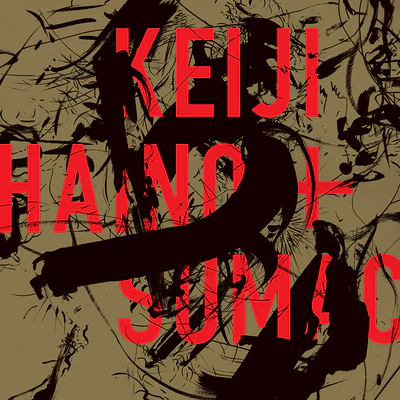
For American Dollar Bill - Keep Facing Sideways, You're Too Hideous To Look At Face On, Keiji Haino and SUMAC met up in Tokyo’s Goksound recording studio to track a series of unrehearsed, completely non-premeditated sessions. Captured across several reels of tape, the collaboration harnessed Haino’s tension-inducing use of empty space on songs like “I’m over 137% a love junkie, and it’s still not enough” while pushing SUMAC’s dissident metal vocabulary on “What have I done (I was reeling in something white...)”. Throughout the course of its hour-plus length, American Dollar Bill pushes and pulls at the strictures of metal and bends the stylistic formalities of improvised music to create a sonic purge unencumbered by convention.
Japan’s fearless multi-instrumentalist and cultural provocateur Keiji Haino has made a career out of his free-form musical improvisations and diverse collaborations. Whether deconstructing American blues to a few rogue notes hanging across chasms of empty space in his solo endeavors, sparring with the nebulous fringes of psychedelia in Fushitsusha, or teaming up with musicians like Faust, Boris, Jim O’Rourke, Stephen O’Malley, John Zorn, and Peter Brötzmann for fleeting aural experiments. Haino’s work is never pre-planned or structured, but rather a completely spontaneous exploration of chemistry, texture, and dynamics.
SUMAC’s tenure is much younger than Haino’s, though guitarist/vocalist Aaron Turner has covered a similarly large swath of musical territory across numerous projects and collaborations, from the sedated drones of recent projects with Daniel Menche and William Fowler Collins to the modern compositions of Mamiffer and all the way back to the restless evolutions of post-metal stalwarts ISIS. With his cohorts Nick Yacyshyn (Baptists, Erosion) on drums and Brian Cook (Russian Circles) on bass, Turner has dissolved the rigid forms of heavy music, searching for a balance between disciplined precision and unhinged musical barbarism, crafting music that vacillates between meticulously detailed instrumentation and uninhibited forays into oblique abstraction.
For American Dollar Bill - Keep Facing Sideways, You're Too Hideous To Look At Face On, Keiji Haino and SUMAC met up in Tokyo’s Goksound recording studio to track a series of unrehearsed, completely non-premeditated sessions. Captured across several reels of tape, the collaboration harnessed Haino’s tension-inducing use of empty space on songs like “I’m over 137% a love junkie, and it’s still not enough” while pushing SUMAC’s dissident metal vocabulary on “What have I done (I was reeling in something white...)”. Throughout the course of its hour-plus length, American Dollar Bill pushes and pulls at the strictures of metal and bends the stylistic formalities of improvised music to create a sonic purge unencumbered by convention.
Description
Japan’s fearless multi-instrumentalist and cultural provocateur Keiji Haino has made a career out of his free-form musical improvisations and diverse collaborations. Whether deconstructing American blues to a few rogue notes hanging across chasms of empty space in his solo endeavors, sparring with the nebulous fringes of psychedelia in Fushitsusha, or teaming up with musicians like Faust, Boris, Jim O’Rourke, Stephen O’Malley, John Zorn, and Peter Brötzmann for fleeting aural experiments. Haino’s work is never pre-planned or structured, but rather a completely spontaneous exploration of chemistry, texture, and dynamics.
SUMAC’s tenure is much younger than Haino’s, though guitarist/vocalist Aaron Turner has covered a similarly large swath of musical territory across numerous projects and collaborations, from the sedated drones of recent projects with Daniel Menche and William Fowler Collins to the modern compositions of Mamiffer and all the way back to the restless evolutions of post-metal stalwarts ISIS. With his cohorts Nick Yacyshyn (Baptists, Erosion) on drums and Brian Cook (Russian Circles) on bass, Turner has dissolved the rigid forms of heavy music, searching for a balance between disciplined precision and unhinged musical barbarism, crafting music that vacillates between meticulously detailed instrumentation and uninhibited forays into oblique abstraction.
For American Dollar Bill - Keep Facing Sideways, You're Too Hideous To Look At Face On, Keiji Haino and SUMAC met up in Tokyo’s Goksound recording studio to track a series of unrehearsed, completely non-premeditated sessions. Captured across several reels of tape, the collaboration harnessed Haino’s tension-inducing use of empty space on songs like “I’m over 137% a love junkie, and it’s still not enough” while pushing SUMAC’s dissident metal vocabulary on “What have I done (I was reeling in something white...)”. Throughout the course of its hour-plus length, American Dollar Bill pushes and pulls at the strictures of metal and bends the stylistic formalities of improvised music to create a sonic purge unencumbered by convention.