🚚 Kostenloser weltweiter Versand für alle Bestellungen!Jetzt einkaufen
V/A - Would It Sound Just As Bad If You Played It Backwards? A Collection of Sounds from the Studio Eksperymentalne Polskiego Radia (1959-2001) Vol. I DLP
“Would It Sound Just As Bad If You Played It Backwards?”
A Collection of Sounds from the Studio Eksperymentalne Polskiego Radia (1959-2001)
Vol. 1
“Would it sound just as bad if you played it backwards?” assembles a collection of audio experiments created at the Polish Radio Experimental Studio (PRES) from 1959 to the beginning of the millennium. These exceptional works are presented alongside images from the Polish artist Zofia Kulik, whose career has spanned over 50 years, beginning in the late 1960s until the present day.
While PRES and Kulik remain important instances in the recent history of the Polish avant-garde, presenting them together in one release may not seem like an obvious choice. There are, of course, some historical intersections — the most notable being a shared interest in Polish architect Oskar Hansen’s Open Form theory which encouraged a modular theory of architecture that combined strategies of indeterminacy with collective participation. Hansen’s ideas influenced Kulik’s early works and also manifested in the PRES’s legendary “black room” music studio which was designed by Hansen himself, and was equipped with moveable sound panels that absorbed or reflected sound to promote a greater, creative freedom from its users. And yet, as it usually goes, the most obvious connections are usually the most deceitful. Whereas Kulik initially followed Open Form, she later turned away from it. And as for the black room—it mostly worked in theory but not in practice. What is it then that makes the two work together?
Within the realm of art history, Kulik’s work is often divided into two periods: her early, artistic endeavors connected to Open Form, and the KwieKulik collaboration, followed by her later turn towards a closed form, characterized by a departure from processual art in favor of material, ("closed") works of art. Yet these terms don’t necessarily bring out the essence of Kulik’s works. The artist explained that Hansen’s Open Form was important in how it opened his students to perceive their environments in a different way. Reminiscing about those times, she states, “I wanted to catch the moment when the object I was looking at was real. I decided that as a static item it can never be real — it’s possible only in the process of looking at it. That translates to the object being recorded and presented in certain sequences [...] there’s an astonishment in the materiality of objects, colours, transformations.”
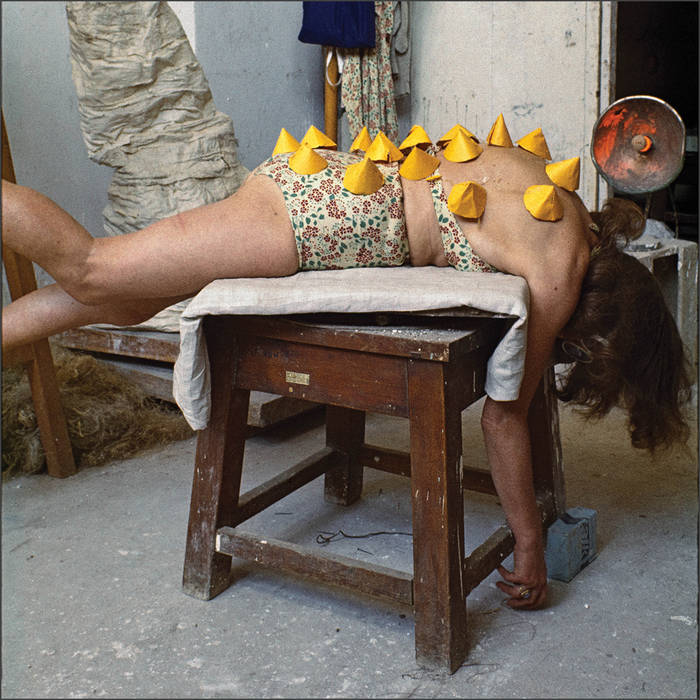
Kulik’s works chosen for this release are taken from two projects, Lady Halina and Cones and Excursion with White Screen. Route: Cemetery, The Palace of Culture (1968-71), which were included in Kulik’s diploma at the Sculpture Department of the Academy of Fine Arts in Warsaw. The projects were slide projections presented on three screens, with specific temporal sequencing. Lady Halina and Cones presents a woman’s body, its forms, geometrical figures, and shapes undergoing a process of transformation. About Excursion with White Screen, Kulik says "this white sheet was supposed to signify an empty screen in different spatial situations in the city. I thought that I would later project a slide onto that screen, imposing another image afterwards, like a collage, but suddenly that screen became a material object instead of an abstract, pure idea of a potential image within an image. It became an object in of itself and I began to notice that the screen sometimes wrinkled in the cemetery, and sometimes moved with the wind.” A myriad of new meanings and references today from Kulik’s sequenced projects. From the perspective of a young woman, Lady Halina and Cones poses questions about the objectification of women, the boundaries of their agency, and the recognition of their subjectivity within the patriarchal world in which their bodies often function as objects of control. In Excursion with White Screen the symbolism of a clear white sheet placed against a background image of the cemetery or the Palace of Culture questions the role of these religio-political monuments, the white screen acting as an empty, and potentially alternative, space between them.
The music chosen for “Would it sound just as bad if you played it backwards?” spans almost the entire history of the Polish Radio Experimental Studio, including tracks as early as Włodzimierz Kotoński’s Concrete etude, Study for One Cymbal Stroke (1959), and ending chronologically with Wolfram’s rendition of Bogusław Schaeffer’s Symphony. Electronic Music (2001). Just as with Kulik’s works, the contemporaneity of the works presented is astonishing. The album opens and closes with Krzysztof Knittel’s 1980s compositions, Lapis and Poko, which perfectly encapsulate his descriptions of his experience in the studio: “We acted without any initial plans or electronic scores, there were no goals to be achieved, no creative method defined in advance. We used our aesthetic and technological knowledge freely, the shapes of tracks emerged during our shared work in the studio.”
The album also includes Mictlan I (1987) and Yes and No (1990), two stunning works by Magdalena Długosz, who studied composition with Krystyna Moszumańska-Nazar and music theory with Józef Patkowski. Since 1979 she has been teaching in the Electroacoustic Music Studio at the Academy of Music in Kraków.
Also featured is the avant-garde composer Elżbieta Sikora, Knittel’s fellow member fromthe KEW Composers’ Group, with her stark pieces Letters to M (1980) and View from the Window, (1971), and Barbara Zawadzka, whose Greya (1987) is meant to evoke different sequencings of the colour grey. In this piece, particularly, it’s hard not to appreciate the similarity to Kulik’s notion of sequencing and transformation of objects.
Bernadetta Matuszczak’s Libera me (1991) is an example of a somewhat different creative experience. In a radio interview conducted by Marek Zwyrzykowski in 1992, the composer stated that she wasn’t intending to discover any “extraordinary electronic effects”, instead she focused on the piece’s “expressive layer.” With the help of Tadeusz Sudnik from PRES, she incorporated into Libera Me the characteristic melody from the Polish version of the Orthodox hymn Święty Boże, Święty Mocny [Holy God, Holy Mighty, Holy Immortal] and combined it with sounds of explosions and instrumental recordings in response to the US’s interventions during the Gulf War.
Eugeniusz Rudnik, the composer and sound engineer whose name is among those most strongly associated with PRES, contributes with his Epitaph for Stones, (1984) a dedication to Jerzy Popiełuszko, the Polish Roman Catholic priest associated with the Solidarity trade union and anti-communist movement who was murdered by the Security Service. Bohdan Mazurek, who took over the reins of the studio from Rudnik in 1962 is also included with his piece Canti (1973).
As mentioned above, the album also includes Włodzimierz Kotoński’s seminal Concrete etude, Study for One Cymbal Stroke, a piece sourced from the single stroke of a mid-sized Turkish cymbal; it is often considered to be an important starting point for the development of experimental music in Poland. And, finally, the album features two performances of Bogusław Shaeffer’s Symphony. Electronic Music, the first by Bohdan Mazurek (1966), which remains very close to the composer’s score, and a contemporary version by Wolfram (2001), which takes much more creative freedom.
In a text about his seminal work, Shaeffer stated that he “decided to include the factor of interpretation in a work that was greatly precise by nature” underlining the importance of shifting elements: “the development of music lies in individual elements shifting in the hierarchy of their functions.” Indeed, an interest in shifting hierarchies seems present in Kulik's powerful images and most of the sound pieces contained in this release. When the Polish Radio appointed Eugeniusz Rudnik to present PRES's technical capabilities to a conservative delegation of Soviet composers, he was met with a bitter reply: “Would it sound just as bad, if you played it backwards?” asked the rigid composers to Rudnik. His answer was to create Skalary, (1966) a multiversional piece which could be played from start to finish and from finish to start, at different speeds, as well as with altered left and right channel distribution. This modular openness calls to mind the empty sheet in Kulik's images. Whatever the context, its static emptiness among rigid urban monuments creates space for a different reality than that which those in power had in mind. This brings us back to Kulik's thoughts on her experiences as a student in the late 60s, a pivotal time in which she understood the process of looking and listening as central to reality itself, thereby shattering the rigidity of traditional forms and religio-political power: “I decided that as a static item, an object can never be real — it’s possible only in the process of looking at it.”
A Collection of Sounds from the Studio Eksperymentalne Polskiego Radia (1959-2001)
Vol. 1
“Would it sound just as bad if you played it backwards?” assembles a collection of audio experiments created at the Polish Radio Experimental Studio (PRES) from 1959 to the beginning of the millennium. These exceptional works are presented alongside images from the Polish artist Zofia Kulik, whose career has spanned over 50 years, beginning in the late 1960s until the present day.
While PRES and Kulik remain important instances in the recent history of the Polish avant-garde, presenting them together in one release may not seem like an obvious choice. There are, of course, some historical intersections — the most notable being a shared interest in Polish architect Oskar Hansen’s Open Form theory which encouraged a modular theory of architecture that combined strategies of indeterminacy with collective participation. Hansen’s ideas influenced Kulik’s early works and also manifested in the PRES’s legendary “black room” music studio which was designed by Hansen himself, and was equipped with moveable sound panels that absorbed or reflected sound to promote a greater, creative freedom from its users. And yet, as it usually goes, the most obvious connections are usually the most deceitful. Whereas Kulik initially followed Open Form, she later turned away from it. And as for the black room—it mostly worked in theory but not in practice. What is it then that makes the two work together?
Within the realm of art history, Kulik’s work is often divided into two periods: her early, artistic endeavors connected to Open Form, and the KwieKulik collaboration, followed by her later turn towards a closed form, characterized by a departure from processual art in favor of material, ("closed") works of art. Yet these terms don’t necessarily bring out the essence of Kulik’s works. The artist explained that Hansen’s Open Form was important in how it opened his students to perceive their environments in a different way. Reminiscing about those times, she states, “I wanted to catch the moment when the object I was looking at was real. I decided that as a static item it can never be real — it’s possible only in the process of looking at it. That translates to the object being recorded and presented in certain sequences [...] there’s an astonishment in the materiality of objects, colours, transformations.”
Kulik’s works chosen for this release are taken from two projects, Lady Halina and Cones and Excursion with White Screen. Route: Cemetery, The Palace of Culture (1968-71), which were included in Kulik’s diploma at the Sculpture Department of the Academy of Fine Arts in Warsaw. The projects were slide projections presented on three screens, with specific temporal sequencing. Lady Halina and Cones presents a woman’s body, its forms, geometrical figures, and shapes undergoing a process of transformation. About Excursion with White Screen, Kulik says "this white sheet was supposed to signify an empty screen in different spatial situations in the city. I thought that I would later project a slide onto that screen, imposing another image afterwards, like a collage, but suddenly that screen became a material object instead of an abstract, pure idea of a potential image within an image. It became an object in of itself and I began to notice that the screen sometimes wrinkled in the cemetery, and sometimes moved with the wind.” A myriad of new meanings and references today from Kulik’s sequenced projects. From the perspective of a young woman, Lady Halina and Cones poses questions about the objectification of women, the boundaries of their agency, and the recognition of their subjectivity within the patriarchal world in which their bodies often function as objects of control. In Excursion with White Screen the symbolism of a clear white sheet placed against a background image of the cemetery or the Palace of Culture questions the role of these religio-political monuments, the white screen acting as an empty, and potentially alternative, space between them.
The music chosen for “Would it sound just as bad if you played it backwards?” spans almost the entire history of the Polish Radio Experimental Studio, including tracks as early as Włodzimierz Kotoński’s Concrete etude, Study for One Cymbal Stroke (1959), and ending chronologically with Wolfram’s rendition of Bogusław Schaeffer’s Symphony. Electronic Music (2001). Just as with Kulik’s works, the contemporaneity of the works presented is astonishing. The album opens and closes with Krzysztof Knittel’s 1980s compositions, Lapis and Poko, which perfectly encapsulate his descriptions of his experience in the studio: “We acted without any initial plans or electronic scores, there were no goals to be achieved, no creative method defined in advance. We used our aesthetic and technological knowledge freely, the shapes of tracks emerged during our shared work in the studio.”
The album also includes Mictlan I (1987) and Yes and No (1990), two stunning works by Magdalena Długosz, who studied composition with Krystyna Moszumańska-Nazar and music theory with Józef Patkowski. Since 1979 she has been teaching in the Electroacoustic Music Studio at the Academy of Music in Kraków.
Also featured is the avant-garde composer Elżbieta Sikora, Knittel’s fellow member fromthe KEW Composers’ Group, with her stark pieces Letters to M (1980) and View from the Window, (1971), and Barbara Zawadzka, whose Greya (1987) is meant to evoke different sequencings of the colour grey. In this piece, particularly, it’s hard not to appreciate the similarity to Kulik’s notion of sequencing and transformation of objects.
Bernadetta Matuszczak’s Libera me (1991) is an example of a somewhat different creative experience. In a radio interview conducted by Marek Zwyrzykowski in 1992, the composer stated that she wasn’t intending to discover any “extraordinary electronic effects”, instead she focused on the piece’s “expressive layer.” With the help of Tadeusz Sudnik from PRES, she incorporated into Libera Me the characteristic melody from the Polish version of the Orthodox hymn Święty Boże, Święty Mocny [Holy God, Holy Mighty, Holy Immortal] and combined it with sounds of explosions and instrumental recordings in response to the US’s interventions during the Gulf War.
Eugeniusz Rudnik, the composer and sound engineer whose name is among those most strongly associated with PRES, contributes with his Epitaph for Stones, (1984) a dedication to Jerzy Popiełuszko, the Polish Roman Catholic priest associated with the Solidarity trade union and anti-communist movement who was murdered by the Security Service. Bohdan Mazurek, who took over the reins of the studio from Rudnik in 1962 is also included with his piece Canti (1973).
As mentioned above, the album also includes Włodzimierz Kotoński’s seminal Concrete etude, Study for One Cymbal Stroke, a piece sourced from the single stroke of a mid-sized Turkish cymbal; it is often considered to be an important starting point for the development of experimental music in Poland. And, finally, the album features two performances of Bogusław Shaeffer’s Symphony. Electronic Music, the first by Bohdan Mazurek (1966), which remains very close to the composer’s score, and a contemporary version by Wolfram (2001), which takes much more creative freedom.
In a text about his seminal work, Shaeffer stated that he “decided to include the factor of interpretation in a work that was greatly precise by nature” underlining the importance of shifting elements: “the development of music lies in individual elements shifting in the hierarchy of their functions.” Indeed, an interest in shifting hierarchies seems present in Kulik's powerful images and most of the sound pieces contained in this release. When the Polish Radio appointed Eugeniusz Rudnik to present PRES's technical capabilities to a conservative delegation of Soviet composers, he was met with a bitter reply: “Would it sound just as bad, if you played it backwards?” asked the rigid composers to Rudnik. His answer was to create Skalary, (1966) a multiversional piece which could be played from start to finish and from finish to start, at different speeds, as well as with altered left and right channel distribution. This modular openness calls to mind the empty sheet in Kulik's images. Whatever the context, its static emptiness among rigid urban monuments creates space for a different reality than that which those in power had in mind. This brings us back to Kulik's thoughts on her experiences as a student in the late 60s, a pivotal time in which she understood the process of looking and listening as central to reality itself, thereby shattering the rigidity of traditional forms and religio-political power: “I decided that as a static item, an object can never be real — it’s possible only in the process of looking at it.”
“Would It Sound Just As Bad If You Played It Backwards?”
A Collection of Sounds from the Studio Eksperymentalne Polskiego Radia (1959-2001)
Vol. 1
“Would it sound just as bad if you played it backwards?” assembles a collection of audio experiments created at the Polish Radio Experimental Studio (PRES) from 1959 to the beginning of the millennium. These exceptional works are presented alongside images from the Polish artist Zofia Kulik, whose career has spanned over 50 years, beginning in the late 1960s until the present day.
While PRES and Kulik remain important instances in the recent history of the Polish avant-garde, presenting them together in one release may not seem like an obvious choice. There are, of course, some historical intersections — the most notable being a shared interest in Polish architect Oskar Hansen’s Open Form theory which encouraged a modular theory of architecture that combined strategies of indeterminacy with collective participation. Hansen’s ideas influenced Kulik’s early works and also manifested in the PRES’s legendary “black room” music studio which was designed by Hansen himself, and was equipped with moveable sound panels that absorbed or reflected sound to promote a greater, creative freedom from its users. And yet, as it usually goes, the most obvious connections are usually the most deceitful. Whereas Kulik initially followed Open Form, she later turned away from it. And as for the black room—it mostly worked in theory but not in practice. What is it then that makes the two work together?
Within the realm of art history, Kulik’s work is often divided into two periods: her early, artistic endeavors connected to Open Form, and the KwieKulik collaboration, followed by her later turn towards a closed form, characterized by a departure from processual art in favor of material, ("closed") works of art. Yet these terms don’t necessarily bring out the essence of Kulik’s works. The artist explained that Hansen’s Open Form was important in how it opened his students to perceive their environments in a different way. Reminiscing about those times, she states, “I wanted to catch the moment when the object I was looking at was real. I decided that as a static item it can never be real — it’s possible only in the process of looking at it. That translates to the object being recorded and presented in certain sequences [...] there’s an astonishment in the materiality of objects, colours, transformations.”
Kulik’s works chosen for this release are taken from two projects, Lady Halina and Cones and Excursion with White Screen. Route: Cemetery, The Palace of Culture (1968-71), which were included in Kulik’s diploma at the Sculpture Department of the Academy of Fine Arts in Warsaw. The projects were slide projections presented on three screens, with specific temporal sequencing. Lady Halina and Cones presents a woman’s body, its forms, geometrical figures, and shapes undergoing a process of transformation. About Excursion with White Screen, Kulik says "this white sheet was supposed to signify an empty screen in different spatial situations in the city. I thought that I would later project a slide onto that screen, imposing another image afterwards, like a collage, but suddenly that screen became a material object instead of an abstract, pure idea of a potential image within an image. It became an object in of itself and I began to notice that the screen sometimes wrinkled in the cemetery, and sometimes moved with the wind.” A myriad of new meanings and references today from Kulik’s sequenced projects. From the perspective of a young woman, Lady Halina and Cones poses questions about the objectification of women, the boundaries of their agency, and the recognition of their subjectivity within the patriarchal world in which their bodies often function as objects of control. In Excursion with White Screen the symbolism of a clear white sheet placed against a background image of the cemetery or the Palace of Culture questions the role of these religio-political monuments, the white screen acting as an empty, and potentially alternative, space between them.
The music chosen for “Would it sound just as bad if you played it backwards?” spans almost the entire history of the Polish Radio Experimental Studio, including tracks as early as Włodzimierz Kotoński’s Concrete etude, Study for One Cymbal Stroke (1959), and ending chronologically with Wolfram’s rendition of Bogusław Schaeffer’s Symphony. Electronic Music (2001). Just as with Kulik’s works, the contemporaneity of the works presented is astonishing. The album opens and closes with Krzysztof Knittel’s 1980s compositions, Lapis and Poko, which perfectly encapsulate his descriptions of his experience in the studio: “We acted without any initial plans or electronic scores, there were no goals to be achieved, no creative method defined in advance. We used our aesthetic and technological knowledge freely, the shapes of tracks emerged during our shared work in the studio.”
The album also includes Mictlan I (1987) and Yes and No (1990), two stunning works by Magdalena Długosz, who studied composition with Krystyna Moszumańska-Nazar and music theory with Józef Patkowski. Since 1979 she has been teaching in the Electroacoustic Music Studio at the Academy of Music in Kraków.
Also featured is the avant-garde composer Elżbieta Sikora, Knittel’s fellow member fromthe KEW Composers’ Group, with her stark pieces Letters to M (1980) and View from the Window, (1971), and Barbara Zawadzka, whose Greya (1987) is meant to evoke different sequencings of the colour grey. In this piece, particularly, it’s hard not to appreciate the similarity to Kulik’s notion of sequencing and transformation of objects.
Bernadetta Matuszczak’s Libera me (1991) is an example of a somewhat different creative experience. In a radio interview conducted by Marek Zwyrzykowski in 1992, the composer stated that she wasn’t intending to discover any “extraordinary electronic effects”, instead she focused on the piece’s “expressive layer.” With the help of Tadeusz Sudnik from PRES, she incorporated into Libera Me the characteristic melody from the Polish version of the Orthodox hymn Święty Boże, Święty Mocny [Holy God, Holy Mighty, Holy Immortal] and combined it with sounds of explosions and instrumental recordings in response to the US’s interventions during the Gulf War.
Eugeniusz Rudnik, the composer and sound engineer whose name is among those most strongly associated with PRES, contributes with his Epitaph for Stones, (1984) a dedication to Jerzy Popiełuszko, the Polish Roman Catholic priest associated with the Solidarity trade union and anti-communist movement who was murdered by the Security Service. Bohdan Mazurek, who took over the reins of the studio from Rudnik in 1962 is also included with his piece Canti (1973).
As mentioned above, the album also includes Włodzimierz Kotoński’s seminal Concrete etude, Study for One Cymbal Stroke, a piece sourced from the single stroke of a mid-sized Turkish cymbal; it is often considered to be an important starting point for the development of experimental music in Poland. And, finally, the album features two performances of Bogusław Shaeffer’s Symphony. Electronic Music, the first by Bohdan Mazurek (1966), which remains very close to the composer’s score, and a contemporary version by Wolfram (2001), which takes much more creative freedom.
In a text about his seminal work, Shaeffer stated that he “decided to include the factor of interpretation in a work that was greatly precise by nature” underlining the importance of shifting elements: “the development of music lies in individual elements shifting in the hierarchy of their functions.” Indeed, an interest in shifting hierarchies seems present in Kulik's powerful images and most of the sound pieces contained in this release. When the Polish Radio appointed Eugeniusz Rudnik to present PRES's technical capabilities to a conservative delegation of Soviet composers, he was met with a bitter reply: “Would it sound just as bad, if you played it backwards?” asked the rigid composers to Rudnik. His answer was to create Skalary, (1966) a multiversional piece which could be played from start to finish and from finish to start, at different speeds, as well as with altered left and right channel distribution. This modular openness calls to mind the empty sheet in Kulik's images. Whatever the context, its static emptiness among rigid urban monuments creates space for a different reality than that which those in power had in mind. This brings us back to Kulik's thoughts on her experiences as a student in the late 60s, a pivotal time in which she understood the process of looking and listening as central to reality itself, thereby shattering the rigidity of traditional forms and religio-political power: “I decided that as a static item, an object can never be real — it’s possible only in the process of looking at it.”
A Collection of Sounds from the Studio Eksperymentalne Polskiego Radia (1959-2001)
Vol. 1
“Would it sound just as bad if you played it backwards?” assembles a collection of audio experiments created at the Polish Radio Experimental Studio (PRES) from 1959 to the beginning of the millennium. These exceptional works are presented alongside images from the Polish artist Zofia Kulik, whose career has spanned over 50 years, beginning in the late 1960s until the present day.
While PRES and Kulik remain important instances in the recent history of the Polish avant-garde, presenting them together in one release may not seem like an obvious choice. There are, of course, some historical intersections — the most notable being a shared interest in Polish architect Oskar Hansen’s Open Form theory which encouraged a modular theory of architecture that combined strategies of indeterminacy with collective participation. Hansen’s ideas influenced Kulik’s early works and also manifested in the PRES’s legendary “black room” music studio which was designed by Hansen himself, and was equipped with moveable sound panels that absorbed or reflected sound to promote a greater, creative freedom from its users. And yet, as it usually goes, the most obvious connections are usually the most deceitful. Whereas Kulik initially followed Open Form, she later turned away from it. And as for the black room—it mostly worked in theory but not in practice. What is it then that makes the two work together?
Within the realm of art history, Kulik’s work is often divided into two periods: her early, artistic endeavors connected to Open Form, and the KwieKulik collaboration, followed by her later turn towards a closed form, characterized by a departure from processual art in favor of material, ("closed") works of art. Yet these terms don’t necessarily bring out the essence of Kulik’s works. The artist explained that Hansen’s Open Form was important in how it opened his students to perceive their environments in a different way. Reminiscing about those times, she states, “I wanted to catch the moment when the object I was looking at was real. I decided that as a static item it can never be real — it’s possible only in the process of looking at it. That translates to the object being recorded and presented in certain sequences [...] there’s an astonishment in the materiality of objects, colours, transformations.”
Kulik’s works chosen for this release are taken from two projects, Lady Halina and Cones and Excursion with White Screen. Route: Cemetery, The Palace of Culture (1968-71), which were included in Kulik’s diploma at the Sculpture Department of the Academy of Fine Arts in Warsaw. The projects were slide projections presented on three screens, with specific temporal sequencing. Lady Halina and Cones presents a woman’s body, its forms, geometrical figures, and shapes undergoing a process of transformation. About Excursion with White Screen, Kulik says "this white sheet was supposed to signify an empty screen in different spatial situations in the city. I thought that I would later project a slide onto that screen, imposing another image afterwards, like a collage, but suddenly that screen became a material object instead of an abstract, pure idea of a potential image within an image. It became an object in of itself and I began to notice that the screen sometimes wrinkled in the cemetery, and sometimes moved with the wind.” A myriad of new meanings and references today from Kulik’s sequenced projects. From the perspective of a young woman, Lady Halina and Cones poses questions about the objectification of women, the boundaries of their agency, and the recognition of their subjectivity within the patriarchal world in which their bodies often function as objects of control. In Excursion with White Screen the symbolism of a clear white sheet placed against a background image of the cemetery or the Palace of Culture questions the role of these religio-political monuments, the white screen acting as an empty, and potentially alternative, space between them.
The music chosen for “Would it sound just as bad if you played it backwards?” spans almost the entire history of the Polish Radio Experimental Studio, including tracks as early as Włodzimierz Kotoński’s Concrete etude, Study for One Cymbal Stroke (1959), and ending chronologically with Wolfram’s rendition of Bogusław Schaeffer’s Symphony. Electronic Music (2001). Just as with Kulik’s works, the contemporaneity of the works presented is astonishing. The album opens and closes with Krzysztof Knittel’s 1980s compositions, Lapis and Poko, which perfectly encapsulate his descriptions of his experience in the studio: “We acted without any initial plans or electronic scores, there were no goals to be achieved, no creative method defined in advance. We used our aesthetic and technological knowledge freely, the shapes of tracks emerged during our shared work in the studio.”
The album also includes Mictlan I (1987) and Yes and No (1990), two stunning works by Magdalena Długosz, who studied composition with Krystyna Moszumańska-Nazar and music theory with Józef Patkowski. Since 1979 she has been teaching in the Electroacoustic Music Studio at the Academy of Music in Kraków.
Also featured is the avant-garde composer Elżbieta Sikora, Knittel’s fellow member fromthe KEW Composers’ Group, with her stark pieces Letters to M (1980) and View from the Window, (1971), and Barbara Zawadzka, whose Greya (1987) is meant to evoke different sequencings of the colour grey. In this piece, particularly, it’s hard not to appreciate the similarity to Kulik’s notion of sequencing and transformation of objects.
Bernadetta Matuszczak’s Libera me (1991) is an example of a somewhat different creative experience. In a radio interview conducted by Marek Zwyrzykowski in 1992, the composer stated that she wasn’t intending to discover any “extraordinary electronic effects”, instead she focused on the piece’s “expressive layer.” With the help of Tadeusz Sudnik from PRES, she incorporated into Libera Me the characteristic melody from the Polish version of the Orthodox hymn Święty Boże, Święty Mocny [Holy God, Holy Mighty, Holy Immortal] and combined it with sounds of explosions and instrumental recordings in response to the US’s interventions during the Gulf War.
Eugeniusz Rudnik, the composer and sound engineer whose name is among those most strongly associated with PRES, contributes with his Epitaph for Stones, (1984) a dedication to Jerzy Popiełuszko, the Polish Roman Catholic priest associated with the Solidarity trade union and anti-communist movement who was murdered by the Security Service. Bohdan Mazurek, who took over the reins of the studio from Rudnik in 1962 is also included with his piece Canti (1973).
As mentioned above, the album also includes Włodzimierz Kotoński’s seminal Concrete etude, Study for One Cymbal Stroke, a piece sourced from the single stroke of a mid-sized Turkish cymbal; it is often considered to be an important starting point for the development of experimental music in Poland. And, finally, the album features two performances of Bogusław Shaeffer’s Symphony. Electronic Music, the first by Bohdan Mazurek (1966), which remains very close to the composer’s score, and a contemporary version by Wolfram (2001), which takes much more creative freedom.
In a text about his seminal work, Shaeffer stated that he “decided to include the factor of interpretation in a work that was greatly precise by nature” underlining the importance of shifting elements: “the development of music lies in individual elements shifting in the hierarchy of their functions.” Indeed, an interest in shifting hierarchies seems present in Kulik's powerful images and most of the sound pieces contained in this release. When the Polish Radio appointed Eugeniusz Rudnik to present PRES's technical capabilities to a conservative delegation of Soviet composers, he was met with a bitter reply: “Would it sound just as bad, if you played it backwards?” asked the rigid composers to Rudnik. His answer was to create Skalary, (1966) a multiversional piece which could be played from start to finish and from finish to start, at different speeds, as well as with altered left and right channel distribution. This modular openness calls to mind the empty sheet in Kulik's images. Whatever the context, its static emptiness among rigid urban monuments creates space for a different reality than that which those in power had in mind. This brings us back to Kulik's thoughts on her experiences as a student in the late 60s, a pivotal time in which she understood the process of looking and listening as central to reality itself, thereby shattering the rigidity of traditional forms and religio-political power: “I decided that as a static item, an object can never be real — it’s possible only in the process of looking at it.”
$38.20
V/A - Would It Sound Just As Bad If You Played It Backwards? A Collection of Sounds from the Studio Eksperymentalne Polskiego Radia (1959-2001) Vol. I DLP—
$38.20
Description
“Would It Sound Just As Bad If You Played It Backwards?”
A Collection of Sounds from the Studio Eksperymentalne Polskiego Radia (1959-2001)
Vol. 1
“Would it sound just as bad if you played it backwards?” assembles a collection of audio experiments created at the Polish Radio Experimental Studio (PRES) from 1959 to the beginning of the millennium. These exceptional works are presented alongside images from the Polish artist Zofia Kulik, whose career has spanned over 50 years, beginning in the late 1960s until the present day.
While PRES and Kulik remain important instances in the recent history of the Polish avant-garde, presenting them together in one release may not seem like an obvious choice. There are, of course, some historical intersections — the most notable being a shared interest in Polish architect Oskar Hansen’s Open Form theory which encouraged a modular theory of architecture that combined strategies of indeterminacy with collective participation. Hansen’s ideas influenced Kulik’s early works and also manifested in the PRES’s legendary “black room” music studio which was designed by Hansen himself, and was equipped with moveable sound panels that absorbed or reflected sound to promote a greater, creative freedom from its users. And yet, as it usually goes, the most obvious connections are usually the most deceitful. Whereas Kulik initially followed Open Form, she later turned away from it. And as for the black room—it mostly worked in theory but not in practice. What is it then that makes the two work together?
Within the realm of art history, Kulik’s work is often divided into two periods: her early, artistic endeavors connected to Open Form, and the KwieKulik collaboration, followed by her later turn towards a closed form, characterized by a departure from processual art in favor of material, ("closed") works of art. Yet these terms don’t necessarily bring out the essence of Kulik’s works. The artist explained that Hansen’s Open Form was important in how it opened his students to perceive their environments in a different way. Reminiscing about those times, she states, “I wanted to catch the moment when the object I was looking at was real. I decided that as a static item it can never be real — it’s possible only in the process of looking at it. That translates to the object being recorded and presented in certain sequences [...] there’s an astonishment in the materiality of objects, colours, transformations.”
Kulik’s works chosen for this release are taken from two projects, Lady Halina and Cones and Excursion with White Screen. Route: Cemetery, The Palace of Culture (1968-71), which were included in Kulik’s diploma at the Sculpture Department of the Academy of Fine Arts in Warsaw. The projects were slide projections presented on three screens, with specific temporal sequencing. Lady Halina and Cones presents a woman’s body, its forms, geometrical figures, and shapes undergoing a process of transformation. About Excursion with White Screen, Kulik says "this white sheet was supposed to signify an empty screen in different spatial situations in the city. I thought that I would later project a slide onto that screen, imposing another image afterwards, like a collage, but suddenly that screen became a material object instead of an abstract, pure idea of a potential image within an image. It became an object in of itself and I began to notice that the screen sometimes wrinkled in the cemetery, and sometimes moved with the wind.” A myriad of new meanings and references today from Kulik’s sequenced projects. From the perspective of a young woman, Lady Halina and Cones poses questions about the objectification of women, the boundaries of their agency, and the recognition of their subjectivity within the patriarchal world in which their bodies often function as objects of control. In Excursion with White Screen the symbolism of a clear white sheet placed against a background image of the cemetery or the Palace of Culture questions the role of these religio-political monuments, the white screen acting as an empty, and potentially alternative, space between them.
The music chosen for “Would it sound just as bad if you played it backwards?” spans almost the entire history of the Polish Radio Experimental Studio, including tracks as early as Włodzimierz Kotoński’s Concrete etude, Study for One Cymbal Stroke (1959), and ending chronologically with Wolfram’s rendition of Bogusław Schaeffer’s Symphony. Electronic Music (2001). Just as with Kulik’s works, the contemporaneity of the works presented is astonishing. The album opens and closes with Krzysztof Knittel’s 1980s compositions, Lapis and Poko, which perfectly encapsulate his descriptions of his experience in the studio: “We acted without any initial plans or electronic scores, there were no goals to be achieved, no creative method defined in advance. We used our aesthetic and technological knowledge freely, the shapes of tracks emerged during our shared work in the studio.”
The album also includes Mictlan I (1987) and Yes and No (1990), two stunning works by Magdalena Długosz, who studied composition with Krystyna Moszumańska-Nazar and music theory with Józef Patkowski. Since 1979 she has been teaching in the Electroacoustic Music Studio at the Academy of Music in Kraków.
Also featured is the avant-garde composer Elżbieta Sikora, Knittel’s fellow member fromthe KEW Composers’ Group, with her stark pieces Letters to M (1980) and View from the Window, (1971), and Barbara Zawadzka, whose Greya (1987) is meant to evoke different sequencings of the colour grey. In this piece, particularly, it’s hard not to appreciate the similarity to Kulik’s notion of sequencing and transformation of objects.
Bernadetta Matuszczak’s Libera me (1991) is an example of a somewhat different creative experience. In a radio interview conducted by Marek Zwyrzykowski in 1992, the composer stated that she wasn’t intending to discover any “extraordinary electronic effects”, instead she focused on the piece’s “expressive layer.” With the help of Tadeusz Sudnik from PRES, she incorporated into Libera Me the characteristic melody from the Polish version of the Orthodox hymn Święty Boże, Święty Mocny [Holy God, Holy Mighty, Holy Immortal] and combined it with sounds of explosions and instrumental recordings in response to the US’s interventions during the Gulf War.
Eugeniusz Rudnik, the composer and sound engineer whose name is among those most strongly associated with PRES, contributes with his Epitaph for Stones, (1984) a dedication to Jerzy Popiełuszko, the Polish Roman Catholic priest associated with the Solidarity trade union and anti-communist movement who was murdered by the Security Service. Bohdan Mazurek, who took over the reins of the studio from Rudnik in 1962 is also included with his piece Canti (1973).
As mentioned above, the album also includes Włodzimierz Kotoński’s seminal Concrete etude, Study for One Cymbal Stroke, a piece sourced from the single stroke of a mid-sized Turkish cymbal; it is often considered to be an important starting point for the development of experimental music in Poland. And, finally, the album features two performances of Bogusław Shaeffer’s Symphony. Electronic Music, the first by Bohdan Mazurek (1966), which remains very close to the composer’s score, and a contemporary version by Wolfram (2001), which takes much more creative freedom.
In a text about his seminal work, Shaeffer stated that he “decided to include the factor of interpretation in a work that was greatly precise by nature” underlining the importance of shifting elements: “the development of music lies in individual elements shifting in the hierarchy of their functions.” Indeed, an interest in shifting hierarchies seems present in Kulik's powerful images and most of the sound pieces contained in this release. When the Polish Radio appointed Eugeniusz Rudnik to present PRES's technical capabilities to a conservative delegation of Soviet composers, he was met with a bitter reply: “Would it sound just as bad, if you played it backwards?” asked the rigid composers to Rudnik. His answer was to create Skalary, (1966) a multiversional piece which could be played from start to finish and from finish to start, at different speeds, as well as with altered left and right channel distribution. This modular openness calls to mind the empty sheet in Kulik's images. Whatever the context, its static emptiness among rigid urban monuments creates space for a different reality than that which those in power had in mind. This brings us back to Kulik's thoughts on her experiences as a student in the late 60s, a pivotal time in which she understood the process of looking and listening as central to reality itself, thereby shattering the rigidity of traditional forms and religio-political power: “I decided that as a static item, an object can never be real — it’s possible only in the process of looking at it.”
A Collection of Sounds from the Studio Eksperymentalne Polskiego Radia (1959-2001)
Vol. 1
“Would it sound just as bad if you played it backwards?” assembles a collection of audio experiments created at the Polish Radio Experimental Studio (PRES) from 1959 to the beginning of the millennium. These exceptional works are presented alongside images from the Polish artist Zofia Kulik, whose career has spanned over 50 years, beginning in the late 1960s until the present day.
While PRES and Kulik remain important instances in the recent history of the Polish avant-garde, presenting them together in one release may not seem like an obvious choice. There are, of course, some historical intersections — the most notable being a shared interest in Polish architect Oskar Hansen’s Open Form theory which encouraged a modular theory of architecture that combined strategies of indeterminacy with collective participation. Hansen’s ideas influenced Kulik’s early works and also manifested in the PRES’s legendary “black room” music studio which was designed by Hansen himself, and was equipped with moveable sound panels that absorbed or reflected sound to promote a greater, creative freedom from its users. And yet, as it usually goes, the most obvious connections are usually the most deceitful. Whereas Kulik initially followed Open Form, she later turned away from it. And as for the black room—it mostly worked in theory but not in practice. What is it then that makes the two work together?
Within the realm of art history, Kulik’s work is often divided into two periods: her early, artistic endeavors connected to Open Form, and the KwieKulik collaboration, followed by her later turn towards a closed form, characterized by a departure from processual art in favor of material, ("closed") works of art. Yet these terms don’t necessarily bring out the essence of Kulik’s works. The artist explained that Hansen’s Open Form was important in how it opened his students to perceive their environments in a different way. Reminiscing about those times, she states, “I wanted to catch the moment when the object I was looking at was real. I decided that as a static item it can never be real — it’s possible only in the process of looking at it. That translates to the object being recorded and presented in certain sequences [...] there’s an astonishment in the materiality of objects, colours, transformations.”
Kulik’s works chosen for this release are taken from two projects, Lady Halina and Cones and Excursion with White Screen. Route: Cemetery, The Palace of Culture (1968-71), which were included in Kulik’s diploma at the Sculpture Department of the Academy of Fine Arts in Warsaw. The projects were slide projections presented on three screens, with specific temporal sequencing. Lady Halina and Cones presents a woman’s body, its forms, geometrical figures, and shapes undergoing a process of transformation. About Excursion with White Screen, Kulik says "this white sheet was supposed to signify an empty screen in different spatial situations in the city. I thought that I would later project a slide onto that screen, imposing another image afterwards, like a collage, but suddenly that screen became a material object instead of an abstract, pure idea of a potential image within an image. It became an object in of itself and I began to notice that the screen sometimes wrinkled in the cemetery, and sometimes moved with the wind.” A myriad of new meanings and references today from Kulik’s sequenced projects. From the perspective of a young woman, Lady Halina and Cones poses questions about the objectification of women, the boundaries of their agency, and the recognition of their subjectivity within the patriarchal world in which their bodies often function as objects of control. In Excursion with White Screen the symbolism of a clear white sheet placed against a background image of the cemetery or the Palace of Culture questions the role of these religio-political monuments, the white screen acting as an empty, and potentially alternative, space between them.
The music chosen for “Would it sound just as bad if you played it backwards?” spans almost the entire history of the Polish Radio Experimental Studio, including tracks as early as Włodzimierz Kotoński’s Concrete etude, Study for One Cymbal Stroke (1959), and ending chronologically with Wolfram’s rendition of Bogusław Schaeffer’s Symphony. Electronic Music (2001). Just as with Kulik’s works, the contemporaneity of the works presented is astonishing. The album opens and closes with Krzysztof Knittel’s 1980s compositions, Lapis and Poko, which perfectly encapsulate his descriptions of his experience in the studio: “We acted without any initial plans or electronic scores, there were no goals to be achieved, no creative method defined in advance. We used our aesthetic and technological knowledge freely, the shapes of tracks emerged during our shared work in the studio.”
The album also includes Mictlan I (1987) and Yes and No (1990), two stunning works by Magdalena Długosz, who studied composition with Krystyna Moszumańska-Nazar and music theory with Józef Patkowski. Since 1979 she has been teaching in the Electroacoustic Music Studio at the Academy of Music in Kraków.
Also featured is the avant-garde composer Elżbieta Sikora, Knittel’s fellow member fromthe KEW Composers’ Group, with her stark pieces Letters to M (1980) and View from the Window, (1971), and Barbara Zawadzka, whose Greya (1987) is meant to evoke different sequencings of the colour grey. In this piece, particularly, it’s hard not to appreciate the similarity to Kulik’s notion of sequencing and transformation of objects.
Bernadetta Matuszczak’s Libera me (1991) is an example of a somewhat different creative experience. In a radio interview conducted by Marek Zwyrzykowski in 1992, the composer stated that she wasn’t intending to discover any “extraordinary electronic effects”, instead she focused on the piece’s “expressive layer.” With the help of Tadeusz Sudnik from PRES, she incorporated into Libera Me the characteristic melody from the Polish version of the Orthodox hymn Święty Boże, Święty Mocny [Holy God, Holy Mighty, Holy Immortal] and combined it with sounds of explosions and instrumental recordings in response to the US’s interventions during the Gulf War.
Eugeniusz Rudnik, the composer and sound engineer whose name is among those most strongly associated with PRES, contributes with his Epitaph for Stones, (1984) a dedication to Jerzy Popiełuszko, the Polish Roman Catholic priest associated with the Solidarity trade union and anti-communist movement who was murdered by the Security Service. Bohdan Mazurek, who took over the reins of the studio from Rudnik in 1962 is also included with his piece Canti (1973).
As mentioned above, the album also includes Włodzimierz Kotoński’s seminal Concrete etude, Study for One Cymbal Stroke, a piece sourced from the single stroke of a mid-sized Turkish cymbal; it is often considered to be an important starting point for the development of experimental music in Poland. And, finally, the album features two performances of Bogusław Shaeffer’s Symphony. Electronic Music, the first by Bohdan Mazurek (1966), which remains very close to the composer’s score, and a contemporary version by Wolfram (2001), which takes much more creative freedom.
In a text about his seminal work, Shaeffer stated that he “decided to include the factor of interpretation in a work that was greatly precise by nature” underlining the importance of shifting elements: “the development of music lies in individual elements shifting in the hierarchy of their functions.” Indeed, an interest in shifting hierarchies seems present in Kulik's powerful images and most of the sound pieces contained in this release. When the Polish Radio appointed Eugeniusz Rudnik to present PRES's technical capabilities to a conservative delegation of Soviet composers, he was met with a bitter reply: “Would it sound just as bad, if you played it backwards?” asked the rigid composers to Rudnik. His answer was to create Skalary, (1966) a multiversional piece which could be played from start to finish and from finish to start, at different speeds, as well as with altered left and right channel distribution. This modular openness calls to mind the empty sheet in Kulik's images. Whatever the context, its static emptiness among rigid urban monuments creates space for a different reality than that which those in power had in mind. This brings us back to Kulik's thoughts on her experiences as a student in the late 60s, a pivotal time in which she understood the process of looking and listening as central to reality itself, thereby shattering the rigidity of traditional forms and religio-political power: “I decided that as a static item, an object can never be real — it’s possible only in the process of looking at it.”